
Today we’re going to take a look at birch pollen allergy foods to avoid. Not everyone with a birch pollen allergy will need to avoid these foods, but some will. The reason some people need to avoid foods related to birch pollen is called cross-reactivity.
It’s a fascinating topic to study if you ask me, you’ll want to not only learn about oral allergy syndrome, but also plant families. This can shed light to patterns you see regarding your seasonal allergies and food allergies.
Before we jump in today, It’s so important to remember that no two people are the same. You can take two people with the same diagnosis and they will have different thresholds and different allergy symptoms to the same trigger food. Additionally, if you’re managing young children, please don’t experiment on them. This short article can provide more insight on the topic.
A Bit About Birch Trees
Birch trees have thin leaves that fall off at maturity, and is a hardwood tree. Other notable trees in the same family (Betulaceae) are alder and hornbeams.
In terms of geography, birch trees mainly grow in the northern hemisphere, especially United States (more-so in northern states), UK, most of Europe, Russia, and China.
There are about 75 common types of birch trees grown around the world, and here in the United States, there are about 20 known to be native to certain areas.
Burch is commonly used for plywood and leather oil, but it also food uses as well, including:
- Birch Beer
- Birch Extract (as a flavouring agent)
- Birch Sap
- Popsicle Sticks
- Tea
Common Symptoms of Birch Pollen Allergy
Birch tree allergy sufferers can tell you that birch allergy symptoms should be taken seriously, as some of the symptoms can cause a domino effect with their health. Whilst this is not an exhaustive list, here are some common symptoms of a birch allergy:
- Allergic Rhinitis (Hay Fever Symptoms)
- Asthma Symptoms (or increased severity/frequency for those with asthma)
- Difficulty Breathing
- Itchy Eyes
- Watery Eyes
- Runny Nose
- Itchy Mouth
- Scratchy Throat
- Sneezing
Alleviating Seasonal Allergy Symptoms
If you’re in search of a way to experience fewer symptoms (in regards to your seasonal allergies), there may be some immunotherapy treatment options available to you, depending on your unique medical history and type of allergy. Work with your board-certified allergist and/or your medical care team to make sure treatments are right for you. They’ll be able to look at your unique case history and coupled with their experience, gauge if something may or may not work for you.
Please note, these immunotherapy treatment options are not for IgE based food allergies. Additionally, if at any time you become uncomfortable with a therapy, you can stop. There’s no law that says you have to do this.
Allergy Drops AKA Sublingual Immunotherapy (SLIT)
This works by exposing your immune system to small amounts of what you’re allergic to in hopes of retaining the immune system and developing a tolerance. Allergy drops are also available as tablets, and both are a custom made blend for you.
SLIT is taken orally, rather than delivered as a shot, which can be very beneficial to young children and some adults. You can read more about this treatment here.
Allergy Shots
Allergy shots work similarly to allergy drops. You’re exposed to a small amount of what you’re allergic to in hopes of building tolerance and reducing the severity of your seasonal allergies. The key difference is that this is delivered under the skin, via a shot (needle).
This has been a treatment options for decades, and interestingly, allergy shots are shown to be a bit more effective than allergy drops. In some patients, they start with allergy drops, then graduate to allergy shots to continue treatment. You can read more about allergy shots here.
Antihistamines and Natural Antihistamines
For some patients, they’d rather treat the symptoms, rather than introduce the allergens to their immune system via shots. Over the counter antihistamines and other prescription medications have long been used as part of the treatment plan for seasonal allergy sufferers.
However, in more recent times, consumers/patients have become wary of ingredients in medications (as well as side effects), as well as long term use of any type of medication. Many are now turning to natural antihistamines including Vitamin C, plant extracts, and butterbar to help treat their symptoms.
Both antihistamines and natural antihistamines work by blocking (or reducing) histamine activity in your body. If you’d like to learn more about natural antihistamines and the science behind them, check out this article, then do more research, and talk with your medical team about options.
Remember, no two people are the same. We each have a unique immune system and there’s no guarantee that any of these immunotherapy treatment options will work for you or your child. In some extreme cases, the best way to alleviate the symptoms is to move to more ideal environment. I’ve known many people over the years that have moved great distances to be in an area free of the pollens they’re allergic to.
Cross Reactivity
Now, let’s take a look at cross-reactivity and what it is exactly. In simple terms, this is how cross-reactions work:
- You’re allergic to birch pollen, beef, fish, and peanuts.
- Your immune system knows what those plant and food proteins look like.
- You eat something that has proteins that “look similar”, your immune system is “confused”, and you have a reaction.
- The food with similar proteins is something you’re not allergic to, however, because the proteins looked similar enough, your immune had a reaction.
Another way to think about this is a case of mistaken identity. It’s almost like when you glance and see someone you think you know, only to do a double take and realize you have no idea who they are.
Oral Allergy Syndrome (OAS), Now Called Pollen Food Allergy Syndrome (PFAS)
Oral allergy syndrome, now called pollen food allergy syndrome, is a special type of food allergy. As the name implies, the allergic reactions happen in the mouth (oral). In fact, the fact that most of the allergic reactions are limited to the mouth and throat are what makes this type of food allergy so unique. It’s also why some doctors don’t always make the connection right away.
In easy to understand terms, here’s how oral allergy syndrome works:
A person has a birch pollen allergy and needs to avoid a specific list of foods because the proteins in said foods “look similar enough to the birch pollen” to their immune system that it causes a reaction. They can experience food allergy-like symptoms when consuming foods related to birch.
This is cross-reactivity, however, not every person with pollen allergies manages pollen-food allergy syndrome. In almost every OAS/PFAS patient, all allergic reactions occur above the collar bone, and mainly in the mouth and throat. In some rare cases, the reaction happens outside of this scope, but it’s still OAS.
Many OAS/PFAS patients are able to tolerate the cross-reactive foods if they’re well cooked first, as this denatures the protein so their immune system can “clearly see” that this isn’t the environmental pollen, but something else.
 |
 |
 |
 |
No Two People are the Same
Not everyone who has a birch tree pollen allergy needs to avoid foods related to birch. Not only that, but when it comes to an immune system being “confused”, each person can have a different experience.
For some, there’s a threshold involved, they may be able to eat some raw fruits and raw vegetables that are known to be cross-reactive, and so on. The allergic reaction varies from person to person, but there are some common reactions with oral allergy syndrome which I’ve listed below.
When many patients with OAS peel the food and/or cook the foods related to birch pollen, many self-report that they’re able to eat the food without having an allergic reaction. This is attributed to the denaturing of the protein. Once cooked, the similar proteins that normally cause the allergic reaction “look different enough” to the immune system and now your system knows that the food is fine.
Allergy Season & Pollen Counts
It’s important to keep a close eye on birch pollen counts in your area each year if you’ll be consuming foods related to birch and you manage oral allergy syndrome. Many people have reported that their pollen food allergy syndrome symptoms are worse when there are higher pollen counts.
During pollen season, you’ll also want to be aware of the wind in your area. For some people, keeping windows closed on high wind days is especially helpful.
Remember, no two people are the same and in rare cases, patients can experience more severe allergic reactions, especially with continued exposure to trigger foods. Additionally, not everyone with oral allergy syndrome can consume trigger foods, even when they’ve been cooked or peeled.
You can learn more information about this condition, in this article from Allergic Living, and this helpful info from the Allergy Foundation of America.
Pollens Involved with Oral Allergy Syndrome/PFAS
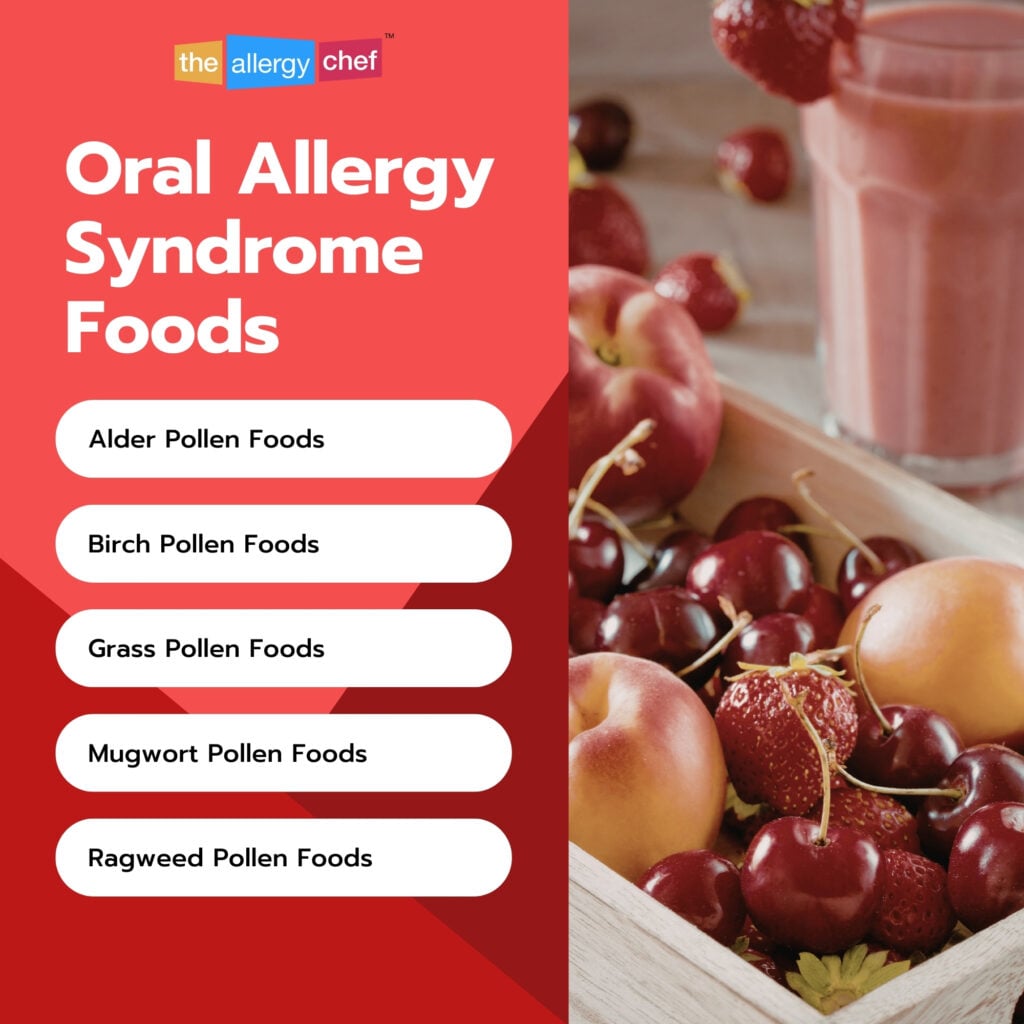
There are five specific pollens at play where OAS is concerned: Alder Pollen, Birch Pollen, Grass Pollen, Mugwort Pollen, and Ragweed Pollen.
In the case of birch, there are quite a few foods that cross-reactive, and can cause allergy-like symptoms to “random” foods. Below you’ll find a list of foods that have the potential for a cross-reactive reaction. If you’d like a more thorough compilation of foods to avoid, be sure to download my OAS guide.
Should you find yourself reacting to different foods outside of the scope of birch pollen and oral allergy syndrome, make an appointment with your doctor. You’ll want to check for a latex allergy (which also comes with cross-reactivity), as well as straightforward IgE mediated food allergies.
Common Symptoms of Oral Allergy Syndrome
the most common symptoms of OAS/PFAS include:
- Chronic Sore Throat
- Generalized Mouth Discomfort
- Itchy Mouth or Itchy Lips
- Scratchy Throat
- Swelling of the Lips, Throat, and/or Tongue
These oral symptoms can increase in severity for some people during high pollen count years, but also if they continue to eat the food (even when peeled or cooked). Be sure to keep a detailed food journal as you go through food trials, should you choose to eat cross reactive foods.
Whiles severe symptoms tend to be rare, as is a life-threatening reaction, should you notice an increase in symptoms, stop your food trials and work with your medical team so they can advise you on the next best steps (and for possible further testing).
Here is a list of foods you’ll need to avoid if you need to eliminate foods related to birch:
Important Note: This is general list of foods to avoid. However, depending on which institute or specialist you refer to, there are more foods to avoid.
If you’d like to see the completely and compiled list I’ve created, be sure to download my Oral Allergy Syndrome Cross Reactive Foods List. It covers the five major pollen types (alder, birch, grass, mugwort, and ragweed). There’s also this info on latex cross reactive foods.
- Almonds
- Apple
- Apricot
- Avocado
- Banana
- Beans in General
- Carrot
- Celery
- Cherries
- Chicory
- Coriander/Cilantro
- Cumin
- Dill
- Fennel
- Fig
- Green Pepper
- Hazelnuts
- Kiwi
- Lentils
- Mango
- Nectarine
- Parsley
- Parsnip
- Peaches
- Peanut
- Pears
- Peas
- Plums
- Prunes
- Potato, White
- Soy Bean
- Strawberry
- Tomato
- Walnuts
- Wheat
For a complete list of all pollen cross reactive foods, be sure to download my OAS Guide. When shopping, be sure to double check labels for herbal teas that are a blend. Any time you see “spices” on a label, you’ll have to assume at least one of the herbs on the list is involved until the brand tells you otherwise.
However, it’s all going to come down to your personal tolerance. If consuming these foods in any form is a risk for you, be sure to contact brands before making purchases.
Raw Vegetables and Fresh Fruits to Enjoy
After seeing that list, you may be wondering, what on earth is left. Here are some of the most common foods you can still enjoy whilst managing oral allergy syndrome, specific to birch trees (this list would be different if you have to avoid other types of pollen).
This is not an exhaustive list. If you’d like to see one, check out the Master Food List on RAISE (membership website).
- Beets
- Broccoli
- Butternut Squash
- Cabbage
- Cauliflower
- Corn
- Cucumber
- Eggplant (aubergine)
- Ginger
- Mushrooms
- Lettuce (a wide range of choices here)
- Radish
- Salsify
- Sea Vegetables (kelp, nori, dulse, etc.)
- Spaghetti Squash
- Sweet Potatoes (these aren’t nightshades like white potatoes)
- Zucchini (courgette)
With this vegetable list, there’s so much good cooking you can do. Paired with different proteins you can make a lot of great meals. If you’re not sure where to start, be sure to check out the Advanced Recipe Search on RAISE where you can mix and match over 100 filters for pollens, individual allergens, food groups, and much more.
Now, let’s look at fruits that you can include in your diet:
- Blackberries
- Citrus Fruit (lemon, lime, grapefruit, orange, mandarin, yuzu, and a whole lot more)
- Currants
- Dates
- Grapes
- Jackfruit
- Melons
- Olives
- Quince
- Pineapple
- Pumpkin
- Raspberries
- Star Apple
- Watermelon
Delicious Birch Pollen Free Recipes
Each of these delicious recipes is gluten free, dairy free, egg free, and very allergy friendly (most are top 9 free or top 14 free).
If you’d like more recipes, RAISE (membership website) has a whole section of birch pollen free recipes for those with OAS. There’s also recipes free from the other major pollens as well.
- Oat Free Protein Muffin Recipe
- Seed, Hazelnut, Vegan, Nut Free Nutella Recipe
- Lemon Poppy Muffins Recipe
- Cinnamon Toast Waffles Recipe
- Chocolate Upside Down Cake Recipe
- Fluffy Raspberry Yuzu Pancakes
 |
 |
 |
 |
 |
 |
Answering Your Birch Allergy Questions
Do I need to avoid tree nuts if I have OAS to birch pollen specifically?
If you’re only allergic to birch, no, you wouldn’t have to avoid all tree nuts. I shared a list of foods to avoid that are cross reactive with birch plants, and you’ll notice that the only three tree nuts on the list are almond, hazelnut, and walnut. Peanuts are also on the list, but they’re legumes, not tree nuts, despite the name.
There are other tree nuts that you’d be able to eat including Brazil nuts, cashews, macadamia nuts, pecans, pine nuts. pistachio, and pili nuts. Additionally, you can also eat tiger nuts, though, they’re tubers, not tree nuts.
If you’d like to learn more about OAS, and see a thorough complied list of foods to avoid for each specific pollen, be sure to download my OAS and Cross Reactivity Guide.
Are there any good substitutes for apples that will feel like I’m eating apple pie?
Quince! In fact, there are a few other types of fruits that can stand in for apple pretty well, and you can read more about them in this Apple Substitutes article. However, quince is a fabulous starting point.
Usually, pear will be the number one suggestion people make, but it’s also cross reactive with birch pollen, so it’s best to avoid pears. Know that you can grill, bake, and stove top cook quince the same way you would apples.
They’re a little more difficult to peel, and a bit harder to cut given their solid nature, but the extra elbow grease is worth it. You can make something akin to applesauce, absolutely make a stunning faux apple pie, and so much more.
Know that quince tastes better when cooked, even though you can eat them in their raw form.
I have a ragweed pollen allergy, birch pollen allergy, and a grass pollen allergy. Where can I find a complete list of foods to avoid?
You can download my OAS and Cross Reactivity Guide. It’s incredibly thorough, as I have yet to find an extensive list that combines all of the research from many major institutions (everyone seems to have a list that’s slightly different). This list takes all of the differences into account.
No matter what, make sure you start keeping a food journal as you make dietary changes to ensure you’ve identified all of your food triggers.
Will allergy testing confirm if I have oral allergy syndrome?
Whilst both skin prick tests and blood tests may be used to help determine your allergies, unfortunately, they aren’t always accurate when oral allergy syndrome is involved. In some patients, their skin prick test is positive to the foods that cause their oral allergy syndrome allergic reactions. In other patients, they get false negatives from their allergy test results (both skin test and blood test).
If your tests are inconclusive, you may be asked to do an oral food challenge. That’s where you eat the food in your doctor’s office and they monitor you for a reaction. During a challenge, your heart rate will usually be raised as well to ensure it’s a true pass. However, know that you can decline a challenge and simply avoid eating the food.
What it will all boil down to in the end is you. If eating a particular food causes you to feel unwell, stop eating the food, even if you don’t have a test to prove you’re allergic to said food.
Can I experience anaphylactic shock if I have food allergies related to my pollen allergies?
It’s very rare that someone with oral allergy syndrome would experience anaphylaxis, however, it’s not impossible. In some cases, the swelling of the throat is so severe the patient can’t breathe. Other severe reactions can include difficulty breathing from chest tightness, and other forms of severe swelling. In some cases, the patient is prone to having severe allergic reactions, and that can carry over to oral allergy syndrome reactions.
Your healthcare provider can review your medical history and advise you on what you’re most likely to experience, however, you should always be prepared, be cautious, and take your diagnosis seriously. In some patients, continued exposure to known allergens elicits a more severe response/reaction with each exposure.
Now that you know that, have hope in this: most individuals with oral allergy syndrome never experience severe adverse reactions. Some even report that their allergic symptoms tend to be mild symptoms, though, that’s a subjective term. I just don’t want you walking around, scared to death of something that may never happen to you. Hence, work with your healthcare provider, as they can give you a lot of insight.
If I cook raw apple or raw peach, will I be able to eat it with pollen-food allergy syndrome?
Many OAS/PFAS patients report that when cross-reactive foods are no longer in their raw form, they’re able to consume them safely. Thanks to the high temperatures, cooking the raw food denatures the proteins so your immune system doesn’t confuse them with birch pollen allergen.
However, this isn’t the case 100% of the time, and no two people are the same. It’s impossible to predict which group you’ll be in. The best course of action is to schedule a supervised oral challenge with your medical care team. Should you pass cooked fruit, you can have a lot of fun with ingredients that are no longer an offending food.
Should I avoid all stone fruits if I have a birch tree pollen allergy?
In theory, no. If you manage OAS/PFAS, the only stone fruits you need to avoid are apricot, cherry, peach, mangoes, nectarines, and plum/prune. There are a lot more stone fruits you can enjoy, and you can see a full list in this Stone Fruit article.
Do know that a lot of people who manage pollen-food syndrome have other conditions as well, so you’d need to take everything into account. For example, if you also have a latex allergy, or other food allergies, those need to be included when you determine which other stone fruits need to be eliminated (if any).
Will taking digestive enzymes help with oral allergy syndrome?
Unfortunately, no. Digestive enzymes help break down foods as they’re in the stomach and as they move through the intestines. Those with oral allergies wouldn’t have the reactions neutralized by the digestive enzymes.
On the flipside, if you have digestive issues, the digestive enzymes could still have some benefit for you, just not where the oral allergies are concerned.
Do I need to avoid all soy products with pollen food syndrome?
It depends on two main things: your unique tolerance levels, and how denatured the soy proteins are. The thing is, this particular type of food allergy is hyper-individualized. This means that you m ay be able to have several soy products whilst the next person with OAS can’t.
In some soy products, the soybean has been processed enough that the denatured proteins no longer look super similar to the birch pollen proteins.
The nice thing is that this specific food comes in a range of products from soy sauce to miso to tofu, and so much more. Soy is also found in a lot commercial foods including vegan foods, candy, snacks, and so on. It’s possible that you’ll be able to eat some, or most of these food products.
You’ll want to work with your medical care team to set up oral challenges. Most likely, they’ll have you do ladder style testing, starting with proteins that are denatured the most, working your way up to minimal processed soy products. This helps them determine your individual tolerance for this specific food.
What seeds would be a good substitute for sunflower seeds (for snacking)?
If you like to eat sunflower seeds straight (I’m assuming with a little pop of salt), I’d start with pumpkin seeds. This brand actually makes a range of seeds for snacking and several are flavoured.
Puffed water lily seeds may also be of interest to you. This brand has a few flavors available. The crunch isn’t anything like a sunflower seed, but it is still crunchy.
What could I use in smoothies and vegan ice creams to replace bananas and their creamy texture?
Bananas sure do deliver an incredibly creamy texture that can be missed. I’d suggest starting with cashews. Soaking them before using them can soften them some, making them easier to blend. It’s not quite the same type of creaminess as bananas, but you’ll have seriously delicious results.
If you’re tree nut free, I’d suggest trying tiger nut butter (tuber, NOT a tree nut), or chickpea butter. Both can help create a creamy mouthfeel similar to bananas.
Now, for the secret weapon you didn’t know about: steamed carrots. I know, it sounds a little out there, but I’ve used it for bespoke recipe development customers that have very limited options and it works like a charm. Is it as creamy as bananas? No. Will you be happy? Yes.
You’ll start by cutting carrots into about 1 inch (2.5cm) long pieces. Try not to go bigger than that because you’ll need them to be blender friendly in the end. Steam the carrots until they’re easy to pierce with a fork. Next, let them cool down. Line a large baking tray with parchment paper and transfer the carrots to the tray. Freeze the tray and once the carrots are frozen solid, transfer them to a freezer baggie. Use the carrots in a smoothie to replace the bananas.
Now, it’s important that you create recipe balance. You’ll need to experiment with different flavour combinations until you find a few that you love.
Is it possible to experience nausea or abdominal pain with oral allergy syndrome?
This is a great question. Yes, it is possible, however, it’s a lot less common. One of the hallmarks of oral allergy syndrome is that almost all reactions happen in the mouth and throat. For some individuals, it’s above the collar bone, as they can get headaches as well.
It’s more rare for a patient to experience symptoms below the collar bone, however, that doesn’t mean it’s impossible. It’s always important to remember that no two people are the same.
However, I’ll also add this. If you regularly experience symptoms outside of the standard scope of oral allergy syndrome, ask your medical team to confirm that you don’t also have a specific IgE food allergy as well. It’s possible to have both conditions, so you’ll want to know how you might respond to an allergenic food.