
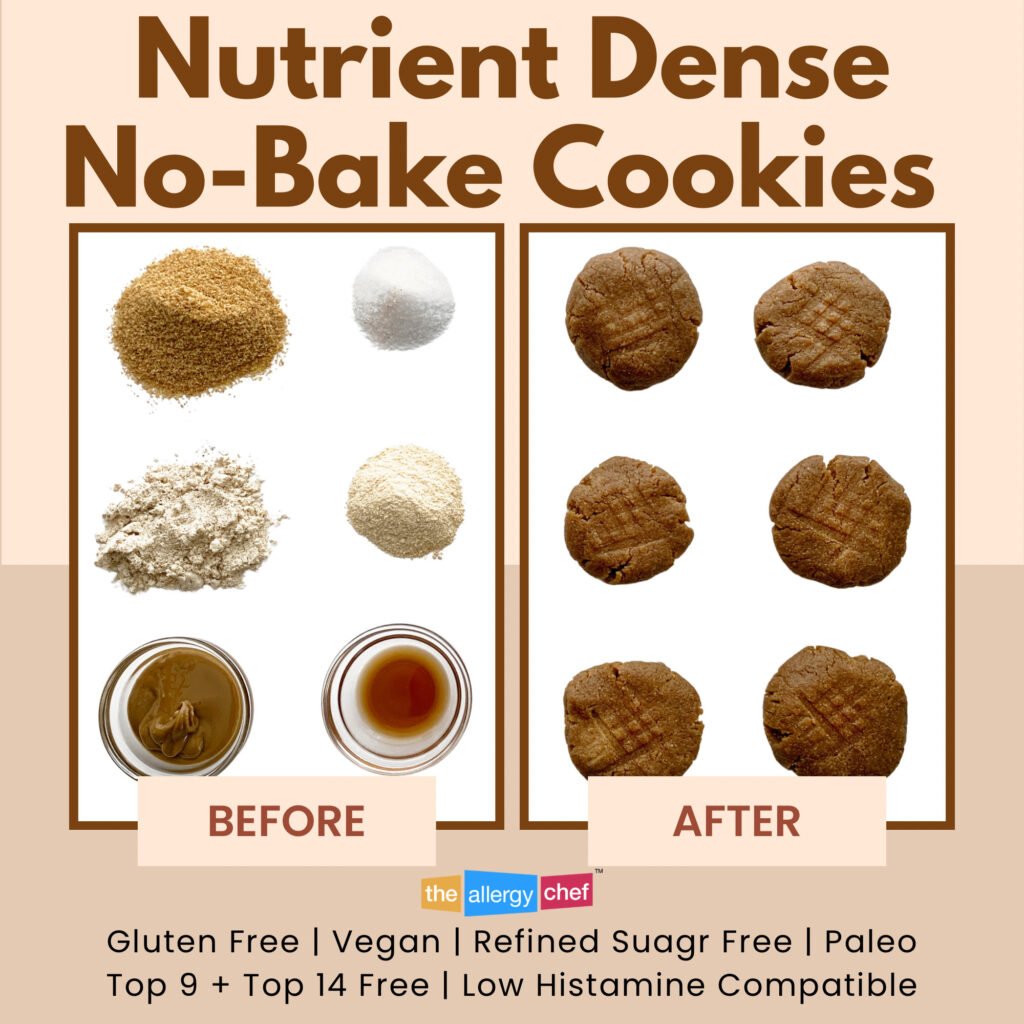
If you manage wheat + egg + nut allergies (or are free from other major allergens), today I’m going to be showing you how to make an awesome (major) allergy free cookie recipe. I’ll show you how to transform simple ingredients into amazing gluten-free cookies that are free from all common allergens (top 9 and top 14, plus many more).
This wonderful recipe really unites the free-from masses from those who make a personal choice to follow a vegan diet, to those with Celiac Disease, to those with multiple food allergies, to those who need a GERD diet, and many more.
So, with that in mind, let’s get to baking!
Allergy Status
Free From: Wheat/Gluten, Dairy, Egg, Soy, Tree Nut (including Coconut), Peanut, Fish, Shellfish, Sesame, Top 9 Allergens, Top 14 Allergens, Alliums, Apple, Avocado, Banana, Beans & Lentils, Berries, Buckwheat, Carrot, Celery, Citrus, Cruciferous, Garlic, Latex Cross Reactive Foods (H/M), Legume, Lupin, Mushroom, Mustard, Nightshade, Oat, Onion, Pea & Pea Protein, Potato (Nightshade Variety), Poultry, Red Meat, Rice, Squash & Gourd, Stone Fruits, Strawberry, Sweet Potato & Yam, Tapioca/Cassava/Yuca/Manioc, Tomato, Yeast
Friendly To: EOE, FPIES, GERD, Low Histamine, Migraine Diet (Cleveland Clinic & Johns Hopkins), Vegan
Low Histamine Reminder: If vanilla extract isn’t tolerated, swap for 2 teaspoons of ground vanilla.
GERD Reminder: Make sure you serve a portion size that works for YOU. With too large a portion, this could be considered a high fat food due to the butter content.
Free-From Basics: What Makes This Cookie Recipe Allergy Free
It’s important to know that anyone can be allergic to anything, and in any combination. No two people are the same, however, some foods have been identified as the most likely to cause an allergic reaction.
When something is called “allergy free”, that doesn’t mean it’s safe for everyone. Instead, it means that it’s free from the most common allergens. Here are the common allergens:
Top 9 Allergen Free as seen in the United States: Wheat, Milk, Egg, Soy, Peanut, Tree Nuts, Fish, Shellfish, and Sesame. As of Jan. 1, 2025, coconut no longer falls under the top 9 allergens.
Top 14 Allergen Free as seen in the EU and other select countries: Cereals Containing Gluten (wheat, rye, barley, oats), Crustaceans, Eggs, Fish, Peanuts, Soybean, Milk, Nuts, Celery, Mustard, Sesame, and Added Sulfite above 10mg/KG.
This dessert recipe is free from gluten, the US top 9, and the EU top 14, which is what makes it an “allergy free cookie”. Now, if you manage less common allergens, be sure to check out the Advanced Recipe Search on RAISE. There, you can choose from over 100 filters to mix and match for allergens and special diets. You can also specify things like dessert, cookies, and so on.
Tools Needed To Make This Allergy Free Cookie Recipe
- Kitchen Scale (this is the one that I love)
- Small Bowl
- Stand Mixer with Paddle Attachment OR Handheld Electric Mixer + Large Bowl
- Baking Tray
- Parchment Paper
- Spatula (this is the one that I really like)
- Cookie Dough Scoop (sometimes called a cookie scoop)

Top 14 Allergy Free Cookie Recipe Ingredients
Flax Gel/Egg
- 3 TBSP Golden Flax Meal
- 6 TBSP Water (room temperature)
Part 1 Ingredients
- 225g Dairy Free Butter of Choice (8 ounces)
- 150g Organic Light Brown Sugar
- 150g Organic White Cane Sugar
- 3 tsp Organic Ground Cinnamon
- 1 tsp Sea Salt
- 1/2 – 1 tsp Organic Ground Cardamom
Part 2 Ingredients
- 250g Sorghum Flour, superfine OR Brown Rice Flour, superfine
- 150g Organic Gluten Free Purity Protocol Oat Flour OR Organic Tiger Nut Flour (tuber, not a tree nut)
- 30g Arrowroot
- 1 TBSP Organic Vanilla Extract
- 3 tsp Baking Powder
- 1/2 tsp Baking Soda
Optional
- 2 tsp Organic Apple Cider Vinegar
Important Ingredient Notes
Flax: Flax seed meal is not the same thing as flax seeds (same plant, different process). For the best results, use this brand of flaxseed meal.
Spices: Most regular grocery stores should have organic cardamom (they’ll have the cinnamon for sure). However, if you can’t find it in your area, you can order online. This is the one that I use.
Butter: If you can have cow’s milk, use unsalted butter in place of the dairy free butter. You can swap this for shortening if needed, but the taste and texture will shift.
Sugar: This recipe calls for a total of 300 grams of cane sugar. There are two types of sugar used to balance the molasses content. However, if you can’t have cane sugar, you can use 280 – 300 grams of organic maple sugar, organic date sugar, or organic coconut sugar in its place. Know that your flavor profile will shift, but you’ll still have delicious treats on your hand.
Gluten-Free Flour Mix: What You Need to Know
Let’s take a moment to talk about the flours used in this amazing gluten-free recipe. The best gluten-free cookie recipes start with a foundation of gluten-free flours. If the flour mixture is wrong, the cookies (or other baked goods) will be a hot mess. Your flour not only impacts the texture of the cookies, but the taste as well, so it’s important that it be well balanced.
It’s important to know that different types of flour are going to produce different results (fluffy texture vs dense texture, delicate crumb, etc.). On top of that, how you combine your flour choices will absolutely impact the final results in both taste and texture.
These delicious cookies have a successful gluten-free flour blend that compliments the warm spices, but also functions very well since this is also an egg free recipe. Know that when eggs are involved, you have a little more wiggle room on the gluten free flour front, as the eggs can help you out of a bad situation.
When it comes to swapping the gluten free flours I have listed, there’s a little space for you to mess about. The sorghum flour can be replaced with superfine brown rice flour. I’ve shared an oat swap, and if possible, the arrowroot needs to stay where it’s at. This starch is important for your final texture.
Now, if you have an all purpose gluten-free flour blend that you’d like to use, you can make that swap. Know that I haven’t tested every gluten free flour mixture on the planet and can’t guarantee your success. I’ve also never worked with 1-1 baking flour type products from Bob’s Red Mill or King Arthur Gluten-Free Measure for Measure. These 1-to-1 baking flour products contain ingredients I’m allergic to (such as xanthan gum which is corn derived).
What I can tell you about these gluten free all purpose flour products is that they aren’t truly all purpose. They’re most purpose, and it’s up to you to know when they’ll succeed. Some manufacturers tell you on the packaging or the website what the product is really good for. I do have it on good authority from a gluten free only recipe developer (she uses eggs) that commercial gluten free flour blends + almond flour = best baking success. I don’t know the exact ratios, so you’ll need to look into it, assuming you can have almonds.
The most important thing to not do: replace the gluten free flours I’ve listed with one singular flour. If you were to take my blend and swap it all for coconut flour, or brown rice flour only, etc., you will absolutely positively ruin the recipe.
Whilst this recipe is clearly for gluten free cookies, if for some reason you don’t need gluten free, you can use a wheat based all purpose flour (sometimes called white flour or regular flour) in place of the sorghum + millet + oat + arrowroot. Don’t use something like whole wheat flour, as it’s not quite the same as an AP flour. Additionally, don’t use something like self-rising flour since this contains a leavening agent, and the recipe already has plenty.
To learn more about choosing flours for gluten free doughs, read this article where I do a deep dive on all things gluten free flour.

Directions
Start by combining your flax and water together in a small bowl and set aside. Additionally, preheat your oven to 325f/163c.
Next, place your empty mixing bowl on your kitchen scale and tare to zero. Add the Part 1 Ingredients, and don’t forget to tare between weighted ingredients. For this recipe I used a stand mixer with the paddle attachment.
Cream (mix) together the butter, sugar, and seasonings (medium speed is a good place to be). After 30 seconds, turn the mixer off and scrape down the sides of your bowl, then mix again to ensure everything is well incorporated.
Turn the mixer off and return it to your scale. Tare, then add the Part 2 Ingredients. If you want to use the optional vinegar for a little extra lift, add it now. Mix everything together on medium speed until thick crumbs form. Now, add your flax gel and mix again until a dough forms.
Line a baking sheet/tray (or two) with parchment paper. Use a medium cookie dough scoop (I love this brand) to portion cookie dough balls. Roll each portion into a ball, place on the parchment paper, and press down a bit. There’s some spread to these cookies, so don’t over-crowd the tray.
Once you have the dough loaded on to the tray, bake cookies at 325f/163c for 16 – 19 minutes. Once you take them out of the oven, allow them to cool on the tray for 10 – 15 minutes before transferring.
If this is your first time making allergy friendly and/or vegan cookies and want to see the process in action, watch the recipe video on this page. It’s for a different cookie recipe, but the process is very similar.
Your total time from start to finish is about 45 minutes. This time is reduced if you have an oven that can handle two large trays of cookies at the same time, or a double oven with one tray of cookies in each oven.
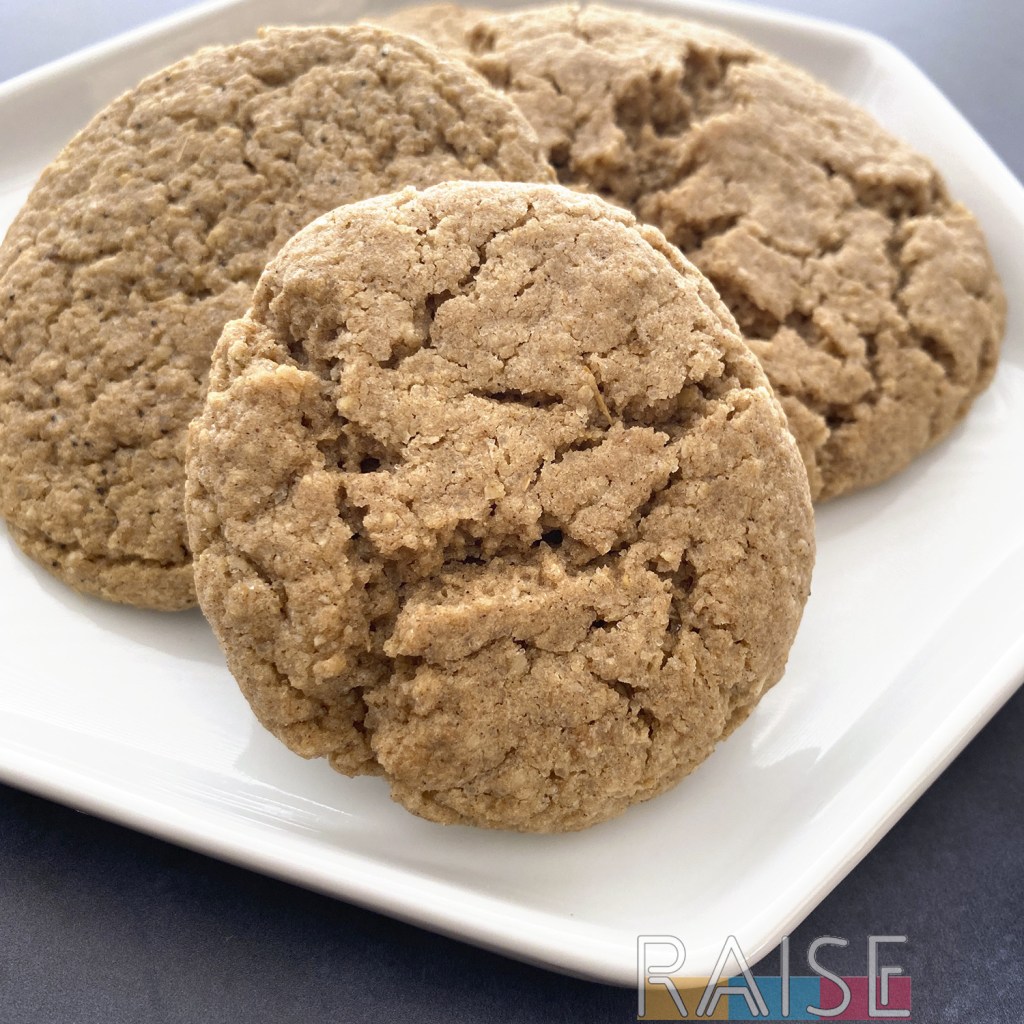
Photo Note: The cookie in the front shows you how a little shaping can make a difference. The cookie below it with a more smooth surface was shaped differently (by my kids). I’m told that both are equally delicious.
If you want more allergy friendly, easy recipes, check out my line of gluten free + allergy friendly cookbooks that cover a wide range of dietary restrictions.
Cardamom Use
If you’re new to cooking or baking with cardamom, make a batch of thees cookies with the 1/2 teaspoon of ground cardamom to test the waters. If you’d like to use more than the full 1 teaspoon, consider increasing the cinnamon a bit as well to keep the ratios balanced.
However, if you are a HUGE cardamom fan, you don’t have to increase the cinnamon if you know going in you’re going to love having a large helping of cardamom in your cookies.
Another way to boost the cardamom flavour is to top your cookies with a spiced glaze. I’d start with something like:
- 100g Organic Powdered Sugar
- 1/2 tsp Organic Ground Cardamom
- 1/4 tsp Organic Ground Cinnamon
- pinch Organic Ground Ginger
- splash Organic Vanilla Extract
- Water (as needed to pul together the glaze, start with 7mL)

Storage
You can leave your allergy free cookies in an airtight container at room temperature for a week. Alternatively, freeze them, which is the preferred method.
To freeze your cookies, place them on a single layer on your large baking tray. It’s OK if the sides are touching. If you need a second layer, place a piece of parchment paper over the first layer of cookies first. The pieces of parchment paper between the layers will prevent the cookies from freezing together and clumping or being hard to separate.
Place the entire baking tray into your freezer. Once the cookies are frozen solid, transfer them to an airtight container. You can store them in a container with a lid, or in a large freezer baggie. Be sure to label your container.
These cookies can be frozen for 4 – 6 months before you start to see a decline in the texture (about 10%). To thaw, leave some cookies out on the counter, at room temperature for 45 – 60 minutes.
More Allergy-Friendly Cookies
These are some of the best cookie recipes that I can share with you if you’re managing food allergies and other dietary restrictions, and you have a sweet tooth.
- Vegan “Peanut Butter” Cookies (can be made with peanut butter, or your safe spread/butter)
- Allergy-Friendly Sugar Cookies (this cakey vegan sugar cookie is great for sharing with friends)
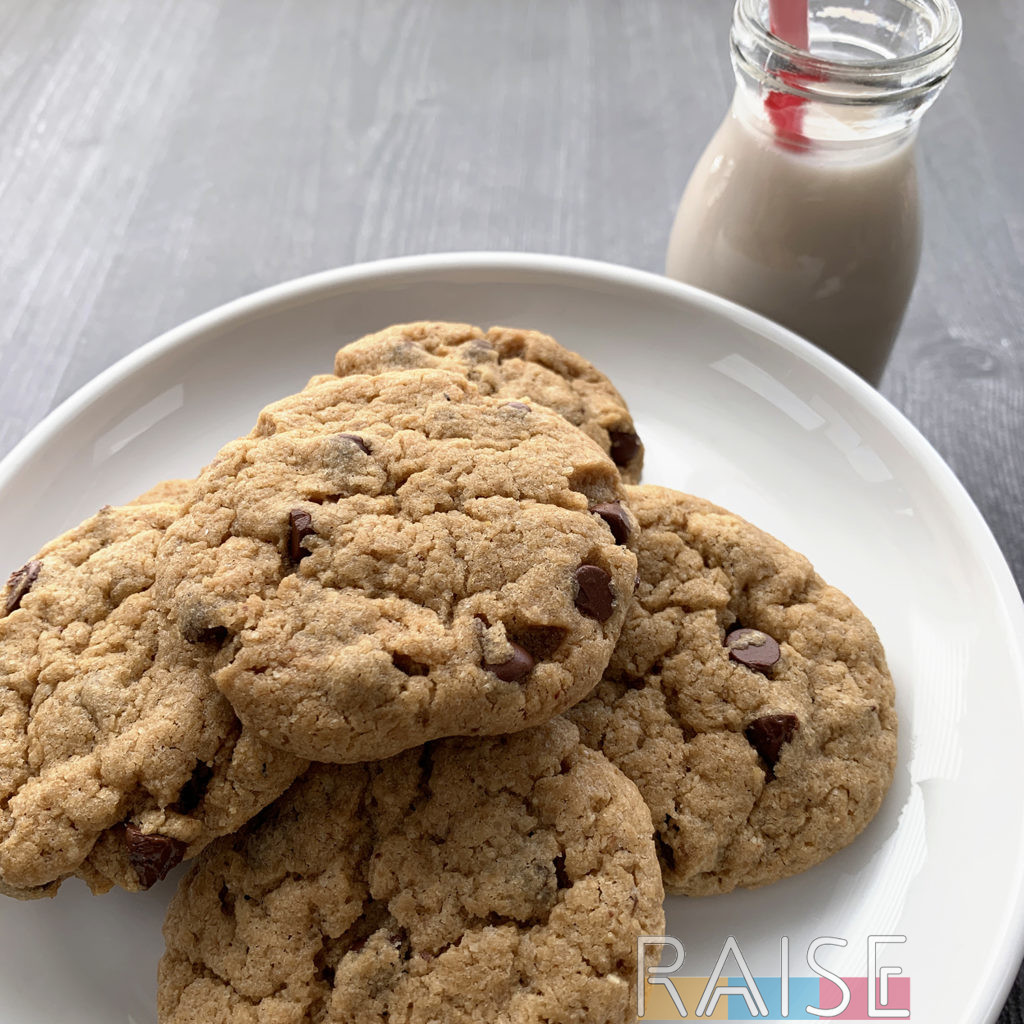
- Top 9 Free Chocolate Chip Cookies (this delicious recipe was a top seller at the free-from bakery I owned and operated for years)
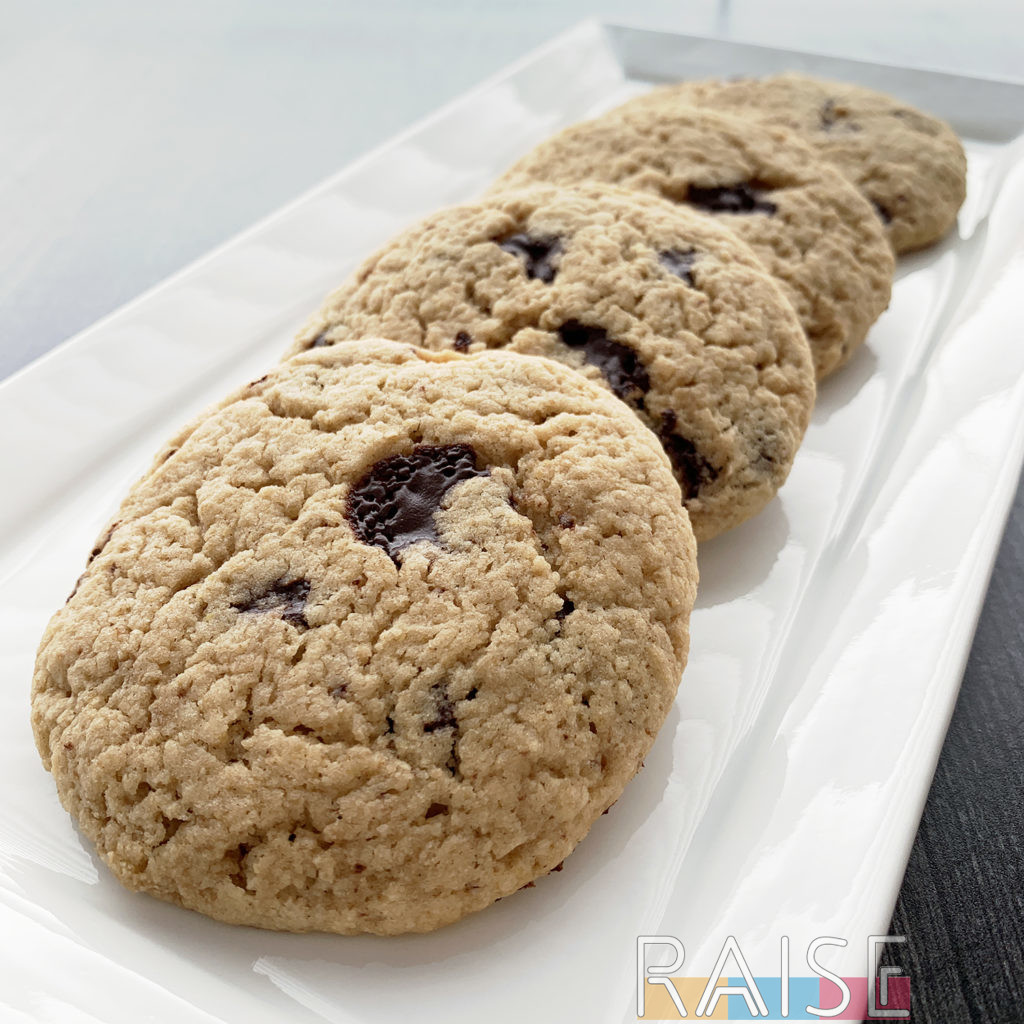
- Refined Sugar Free, Gluten Free, Dairy Free Vegan Chocolate Chip Cookies
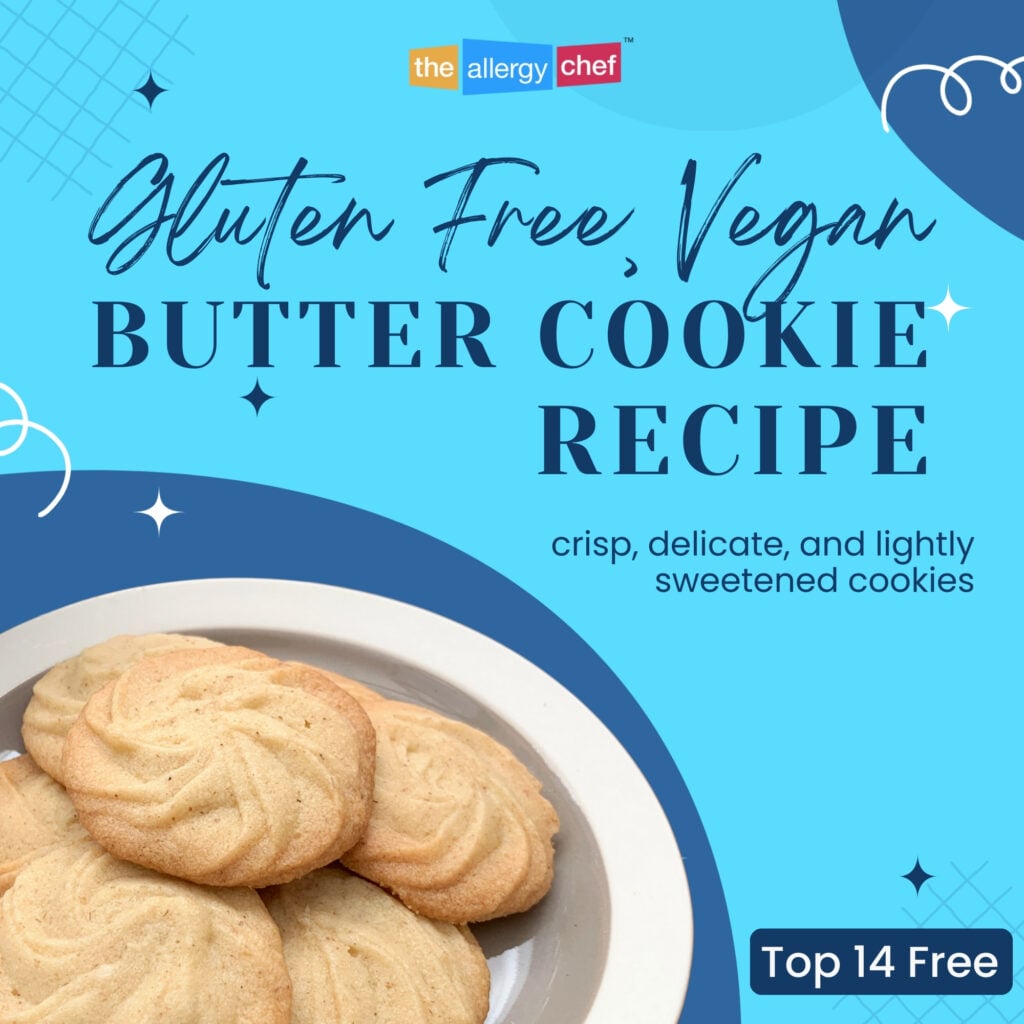
- Vegan Danish Butter Cookies (top 9 free + top 14 free, super tasty and lightly sweetened)
- Gluten Free Gingerbread Cookies Recipe (great for making gingerbread men)
 |
 |
 |
 |
 |
 |
Change It Up
There are many ways you can change up this tasty top 14 allergy free cookie recipe. Here are a few ideas to get you started:
Make a homemade egg free royal icing (essentially a simple glaze) and pipe it on. Your glaze can be vanilla, cinnamon, or chocolate. All three of these flavours will compliment the cookie recipe.
Fold in chocolate chips. Both Enjoy Life and Pascha have very allergy friendly chocolate chips. You can see more dairy free, vegan, and allergy friendly chocolate chip options (including a truly corn free dark chocolate) here.
Add organic ground ginger with the wet and dry ingredients in Part 1. Use 1/2 teaspoon if you like ginger, and use 1.25 teaspoon if you LOVE ginger.
Swap the cinnamon for allspice with the dry and wet ingredients in Part 1.
Create a caramelized pear compote to serve alongside the cookies. Alternatively, you could create a fresh pear salsa to pair with these cookies.
Make double chocolate chip cookies by using a combination of dairy free milk chocolate chips and dairy free white chocolate chips (this is the top 14 free brand that I use).
Add a glaze and sprinkles! Not all allergy friendly sprinkles bake well. The easiest way to avoid a literal sprinkle meltdown is to add your sprinkles after baking. To get your sprinkles to adhere to the cookies, you’ll want to use a glaze or melted chocolate. For glazing, make a simple powdered guar glaze, pipe that on your cookies, then top with safe-for-you sprinkles.
Make cookie bars!
Cookie bars are essentially a large baked cookie and a topping. Once cooled, you cut it into granola bar shapes, or squares. To make cookie bars, line your baking sheet with parchment paper. Transfer all of the cookie dough to the tray, then cover with a large piece of parchment paper.
Use your hands or a rolling pin to evenly distribute the cookie dough all over the tray. Now, you bake. If you want an easy chocolate topping, sprinkle dairy free, vegan chocolate chips all over the top. Bake the cookie and when it’s ready, take it out of the oven. Immediately use an offset spatula to spread the melted chocolate. Allow the cookie to cool 100% on the tray before slicing.
The alternative is to bake the large cookie/tray, and when it’s done, take it out of the oven. Allow it to cool 100%, then spread on a topping. It could be a homemade ganache with melted chocolate bars and dairy free milk (oat milk, rice milk, etc.), some kind of frosting, or even a combination of the two.
Either way, know that when you bake a large tray of cookie, your bake time will increase to anywhere between 30 – 40 minutes. The height of the cookie makes a big difference in the bake time. To test for doneness, I usually take a fork and break off a small corner that no one will notice once I’ve covered it all up. Yup, that’s my official advice as a published cookbook author 😉

Free-From Food Inspiration
As someone who lives with over 200 dietary restrictions due to food allergies and food intolerances, I want to take a moment to INSPIRE you. It doesn’t matter what your dietary restrictions are. Where there’s a will, there’s a way. Perhaps traditional cookies aren’t on the menu anymore, but that doesn’t mean you can’t take the safe ingredients that you have, and turn them into something new.
In fact, that’s where the inspiration for these vegan cookies came from. Rather than reinvent classic cookies, I wanted to show people that they can have incredible experiences, and create new food memories with friends and family.
So, as you go about your baking, put on some good music, dance, and love your safe bites.
Answering Your Questions About This Allergy Free Cookie Recipe
Can I use a different egg replacer in place of the flax seed?
When it comes to making these top 14 allergy free cookies, please don’t make that swap, as there’s a very good chance you’ll ruin the recipe. Most commercial vegan egg replacement options provide lift, not bind. This recipe was purpose built from the ground up to account for all major aspects of an egg (lift, moisten, binding).
If you were to remove the bind and essentially add more lift, you’ll end up with a terrible after taste since you’ll have leavening overload, and the cookies will absolutely crumble. Essentially, you’d have an expensive hot mess, and I don’t want that for you.
Could I make this recipe in a food processor?
This allergy free cookie recipe should be made in a stand mixer, or with an electric handheld mixer. The amount of dough that’s created would be too much for your food processor. Additionally, food processors don’t quite whip the same way a stand mixer would.
Now, if I were on a desert island and a food processor was the only tool I were allowed, and magically I had the ingredients for these cookies (it’s a generous island), I’m using the food processor. It’s my only tool, and I’m going to manage my expectations. I’ll also have to cut the recipe in half, or down to 25% to make sure it fits into the food processor.
If you’re in a pinch, go for it, but know that you won’t have the same results as me. Happy baking! And don’t get trapped on a desert island.
Will this cookie dough work with a cookie cutter?
You miiiigghttt be able to use this cookie dough with a cookie cutter. It isn’t something that I’ve tested, however, knowing how the dough behaves, I think you have at least a 50% chance of success.
I suggest removing a small amount of cookie dough, using a rolling pin to roll it out (this is the adjustable height rolling pin that I use and it’s EPIC), then cut a few shapes. Once you have the shapes on parchment paper and on your baking tray, chill the tray for 30-60 minutes. After chilling, pop the tray straight into your preheated oven and do the test bake. If they hold their shape well, proceed with more cookie cutter fun. If they don’t, then you’ve only used up a small amount of your cookie dough on the experiment. Either way, have fun!
Can I use chia seeds instead of flax meal?
No, you can’t use chia seeds in place of the flax meal. However, you can use chia seed meal in place of the flax meal. Seeds and meal are from the same plant, but the grinding process makes the gelling happen totally different.
This is the brand of chia seed meal that I purchase, and it’s the best one for the job. You’ll want to use 3 TBSP chia seed meal + 9 TBSP room temperature water to make your gel. However, you also need to manage your expectations. This swap will create about a 5% difference in taste, as well as a change in texture and overall appearance.
Could I use a tablespoon of baking soda instead of the baking powder?
I’m so glad you asked because the answer is no. Like, a really strong, spit out your dessert kind of no. Here’s why: the flavors of baking soda and baking powder are different, as are their core behaviours.
If you follow any of my cookie recipes, you’ll see that I call for a half teaspoon baking soda because even one teaspoon baking soda can wreck a great recipe. If you’ve run out of baking powder, this baking powder recipe is a good starting point.
Additionally, check out this article on baking powder vs baking soda if you’d like to learn the science behind the baking.
Should I cool the cookies on a wire rack?
No, in fact, it’s important that you cool the cookies on the tray for at least 10-15 minutes, or longer. The tray cooling method taps into “carryover cooking”. It’s where we take advantage of the residual heat on the baking tray to continue to cook this dessert. In gluten free + vegan + free-from baking, this is a huge part of the process.
A cooling rack has no heat, and introduces more air flow, which can rapidly cool your cookies. We don’t want that, so, with this recipe, cool them on the baking tray. If you’d like to transfer to a cooling rack after the 15 minutes, that’s fine, but not necessary.
Is it possible to make a sugar-free allergy free cookie?
For this style of recipe, it’s possible to make a refined sugar free, allergy free cookie recipe. Sweeteners such as maple sugar, date sugar, and coconut sugar can be used to sweeten the cookie.
However, once you venture into the world of what I like to call special sweeteners (allulose, Swerve, monk fruit, Stevia, etc.) all the rules go out of the window. A lot of these sugars require a special preparation before using them, and they’re not a 1:1 swap for other sweetener options.
With that in mind, if you need to use a special sweetener, I suggest visiting the manufacturer’s website and following one of their recipes instead. You need to know the proper ratios for fat:sweetener:flour. Alternatively, search online for “sugar free top 9 free cookie recipe” or “sugar free top 14 free cookie recipe” depending on what your needs are.
Are these allergy free cookies easy to bake?
Yes!! In fact, if you have any experience in baking (perhaps you’ve baked chocolate chip or oatmeal cookie recipes in the past), you’ll find this allergy free cookie recipe easy to make. The cookie dough preparation is no different from a standard cookie with allergens (combining fat + sugar, adding dry ingredients, and so on).You’ll still use a cookie scoop to portion dough, you don’t need a special baking tray, and you bake like any other cookie recipe.
The only thing that really makes this cookie recipe different is the base ingredients that you’ll be working with. I promise, this is no harder to make than a wheat + egg based cookie recipe.
Could I use coconut oil in place of the butter?
When you make these tasty top 14 free cookies, you could make that swap since coconut oil is also solid at room temperature. However, know that you’ll be changing the overall taste and texture of the cookie as well. If you don’t LOVE coconut flavor, absolutely do not make this swap.
Also know that you cannot swap for an oil that’s liquid at room temperature such as olive oil. You can however do a 1:1 swap for organic shortening (this is the one that I use), but this swap will also change the taste and texture a good amount.
Is a cookie sheet the same thing as a baking tray?
A cookie sheet and a baking tray (sometimes called a baking sheet) are similar, but not quite the same. Unfortunately, a lot of homemade cookie recipes online use the terms interchangeably. A baking tray is solid, without holes, and generally has some weight to it, which prevents warping. It’s also usually dishwasher safe.
On the other hand, a cookie sheet is lighter, usually doesn’t have a lip/raised border, and often has small holes all over to promote better airflow. These slight changes allow for most cookie dough balls to bake up to cookie perfection.
In terms of if you’ll see a huge difference between the two, that’s going to depend on the cookie recipe. Some genuinely require improved airflow to perform their best. If you’re following my recipe, know that for the best eggless oatmeal cookies, you’ll only need a standard baking tray.
What’s the best dairy free butter to use?
I use the Earth Balance 30 pound food service box, which I know, is a lot. But! It’s top 9 free. Outside of that, rather than talk your ear off, I’m going to point you to this section of my Ultimate Guide to Dairy Free Substitutes on all things dairy free butter. There’s a list of brands that sell dairy free + vegan butter and I note what the bases are.
Will I have crispier cookies if I bake them for longer?
Not exactly. You’ll have harder, crunchier cookies, rather than crispier cookies. The difference between crisp and crunch can be thought of like snapping a tortilla chip versus breaking apart heavily toasted bread. One is light and airy when compared to the heavier counterpart.
Baking for longer essentially gives you cookie toast rather than cookie crisp. For a crispier cookie, you can press your cookies down on the flat side, and do a test bake. Start with a 15 minute bake time and go from there.
Can I sweeten this cookie with applesauce instead of sugar?
No, this allergy free cookie recipe isn’t designed to be sweetened with a liquid + whole food sweetener like applesauce (or date paste). You’ll need to swap for another granulated sweetener (maple sugar, date sugar, etc.), or use a different recipe.
If you need a different recipe, you can try searching online for something like “gluten free vegan applesauce cookie recipe”. That would eliminate a lot of major allergens right off the bat, then you may have to make some smart substitutions. Wishing you all the best!