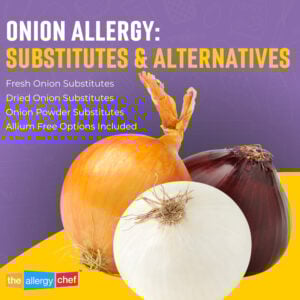
There are so many reasons one may be on the hunt for an onion allergy substitute including following a low FODMAP diet, managing irritable bowel syndrome, or needing to avoid all members of the allium family. No matter the reason, welcome, and I hope you find these onion substitutes super helpful in your cooking adventures.
Different Forms of Onion
When it comes to choosing the best substitute, we first have to look at the different elements of each type of onion. Below I’ve outlined the most version of this root vegetable that you’ll run into, the base flavour information, and how it’s commonly used. After this, we’ll talk about the best onion substitutes.
Cipollini Onions
Best For: Roasting, Braising
Commonly Used For: Stews, Specialty Soups, Oven Roasted Veg, Grilling
Cipollini onions are flat and wide (squished looking) Italian onion. It’s about half to one third the size of a yellow or white onion. It’s less pungent than standard onions and it’s fantastic for roasting whole. If you have someone that wants to eat onion, but finds the taste too strong, cipollini onions are a great alternative.
Pearl Onions
Best For: Oven Roasting, Braising
Commonly Used For: Side Dishes, Serving Whole, Oven Roasted Vegetable Medleys
Pearl onions can be purchased fresh or frozen, and have a sweet and subtle flavour. They’re fantastic for roasting, but can also be used for typical stovetop recipes, so long as you have a the right cooking time as they’re usually used whole.
Red Onion
Best For: Eating Raw
Commonly Used For: Guacamole, Pickled Onions, Salads, Sandwiches
This is a great onion for raw applications, however, plays well with other ingredients when cooked. It’s fabulous for pairing with foods such as lemon and balsamic vinegar.
Spring Onions
Best For: Stir-Fry, GarnishCommonly Used For: Asian Cuisine, Adding Flavor to Recipes at the End of Cooking
Spring onion is also called scallions, and both the green tops and white bulb are edible. It’s common to slice them and use alongside spicy foods, Asian foods, and as a garnish. When eaten raw, usually only the green tops are used.
Sweet Onion
Best For: Frying
Commonly Used For: Gratin, Onion Rings, Roasted Vegetables
Sweet onions contain less sulfur compounds than other onions, which makes them taste sweeter in comparison. In addition to being great for frying, you can also use sweet onion for grilling.
White Onion
Best For: Crunch and Sharp Flavour
Used For: Salsa, Chutney, Stir-Fry
White onions are crunchy, tangy, and great some raw applications, as well as pretty much all cooked applications.
Yellow Onion
Best For: All around cooking
Used For: Braised Meats, Roasted Mea, Sauces, Soups, Stews
If a recipe calls for “onion”, this is usually what it’s referring to.
Ramps (not onions, but close)
Best For: Stovetop Cooking, Stir-Fry
Used For: Specialty Recipes
Ramps, also called wild garlic, wild leek, and ramson is a wild harvested plant native to North America (more common in north eastern states). The leaves and bulbs are both edible. Ramp leaves have a garlicky taste whilst the bulbs are a bit more oniony. Ramps are INCREDIBLY aromatic, but should only be lightly cooked to retain their incredible smell and flavour.
Shallot (not an onion, but close)
Best For: Stovetop Cooking, Recipes with Mild Flavour
Used For: Vinaigrettes, Egg Casseroles, Garnish
Shallots are very aromatic, and don’t require a long cooking time. They’re very popular in French cuisine, and in large amounts are a decent stand in for onions. An onion free kitchen should absolutely have shallots on hand at all times (for ease, you can purchase them dehydrated or freeze dried).
Best Onion Substitutes & Replacement Information
Now, we’re going to talk generalizations, then further below I’ll cover onion substitutes by type. If you’re allergic to onion, the best option for replacing onion will be shallot, ramps (seasonal), and asafoetida (also called hing).
Asafoetida
Also called hing, asafoetida is a lot more common in Indian cooking than in any other global cuisine. I’m told that the smell of this spice isn’t pleasant when you first open the jar. However, once you get to cooking, it takes on a lovely aroma and your final dish will absolutely taste of onion.
Asafoetida can mimic a mild onion flavor, so don’t expect it to blow you out of the water. However, you don’t want to be stingy. A pinch of asafoetida powder won’t do much in a batch of stew or chili where its milder flavor can be easily drowned out.
If a recipe calls for 2 teaspoons of onion powder, you’ll want to start with 1/4 – 1/2 teaspoon asafoetida powder. It’s important to add this at the start of cooking, not near the end of cooking. Asafoetida needs time to cook so the onion flavour develops, and for the unpleasant aroma to cook off. When used properly, some people say this absolutely tastes like the real thing and you won’t need to miss out on onion flavour. You’ll also have the added benefit of tear-free cooking.
For a more complex flavor profile, you can add a tiny pinch of wasabi, or a bit of ginger to bring some zing into the recipe, along with something like fennel seeds or mushroom powder. Ultimately, the end goal is to cook something you’ll love, so use the amount that works best for you.
Leeks
Leeks will have a similar depth of flavor when compared to onions, however, the flavor is different. I don’t want to mislead you and think it will be identical, because it won’t. However, in a hearty sauce or stew, using leeks in place of onions is fantastic. You have the onion quality, but without the onion. Leeks are also a bit sweeter, and a bit milder, so don’t be afraid to use more than what you think you should.
When using leek as an onion substitute, use the white bulb and light green portion of the stem. The green and dark green stems are good for broth, stock, and composting. Also know that leeks grow in sandy soil and commonly have quite a bit of dirt in them. Wash them well several times before using them.
Shallots
As I mentioned earlier, shallots aren’t onions, but they’re part of the allium family, making them an excellent substitute for onions. Their flavour profile is mild and delicate, however, when you use them in a large amount, they absolutely give off onion vibes.
When using shallots as an onion substitute, you’ll want to use a 2:1 ratio on smaller scales, and at least 1.6:1 at larger scales. If the recipe calls for 100g (3.5 ounces) of onion, you’d use 200g of shallot. You could use as low as 180g, but if you want to push the flavour, use the 200g.
On the other hand, if a recipe calls for 1 onion (450g/1lb/16 ounces), you’d want to use at least 700g of shallots in its place. Now, at that amount, your shallots are going to be expensive, making them a not so great substitute for onion.
Different Foods to Bring in Flavour
As someone with years and years of experience in the free-from world, here’s the best advice I can give you. Sometimes, when managing a restricted diet, it’s less about replacing an ingredient 1:1, and instead, leaning in a different direction. At their core, onions tend to have a sweet pungent flavor, some zing, crunch (if raw), and sulfuric compounds that add to the aroma.
Now, in the culinary world, there are ingredients that are amazing in terms of flavor, and when used well, you can create amazing onion free recipes that can stand up to their onion containing counterparts.
Here’s a list of ingredients I think you should experiment with as a home cook that are all outside of the allium family:
- Balsamic Glaze (this isn’t the same thing as balsamic vinegar, it’s more dense and syrup like)
- Chinkiang Vinegar (other black vinegars work, and it’s an interesting category of products)
- Cumin
- Fermented Rice Koji
- Fish Sauce (this brand makes a vegan fish sauce in case you need it)
- Gochujang
- Liquid Aminos (there are soy versions and coconut versions)
- Miso Nooch (made from chickpea and rice)
- Miso Paste
- Mushrooms
- Oyster Sauce
- Teriyaki Sauce
This is such a short list in the grand scheme of things. For each ingredient I’ve listed, there are dozens of options for each one. Plus, this is no where near an exhaustive list. It means that there are tens of thousands of ingredient combinations to explore, all outside of the allium family. So, go forth and explore, and find new foods to enjoy.
Best Onion Substitutes for Different Scenarios
Now that we’ve gone over some generalizations, let’s take a deeper look at very specific onion substitutes. Remember, these are only suggestions. You can always go out on a delicious limb and experiment with more ingredients.
Best Substitutes for Fresh Onions (raw)
Some fresh onions can be eaten raw including spring onions and red onion. However, when you’re substituting for a raw application, you want to mind the water content of a fresh onion, so we don’t want to choose something inherently dry. We also need to think about the crunchy texture that a raw onion will bring to the table.
For a raw application, shallots are going to be the best onion substitute. Use a 1:1 ratio (or up to a 1.7:1) in salsa, guacamole, and other small scale recipes. If you’re making a large recipe or batch cooking, shallots will drive up your costs considerably, so be mindful. You’ll also need to play it by sight and taste. If you’re making a super small batch of guac and LOAD up on shallots, it won’t taste balanced.
You can also purchase freeze dried shallots, blitz them in your spice grinder, and sprinkle that all over in place of a raw application. This can help keep costs down. The flavour will be less intense, but you get to have a quick chop-free onion flavor and lower price.
Beyond shallots, I wouldn’t be too quick to suggest other options only because they should be cooked for best results, and this is all about raw applications.
Excellent Substitutes for Cooked Onions & Sautéed Onions
One of the best things working in our favor when it comes to cooked onions is that they generally sit in the background. Now, there are times when onions are at the forefront (onion tart, French onion dip, etc.), however, we’re going to focus on everyday recipes.
Most cooked recipes are going to call for white onions or yellow onions. You can use a large leek in place of said onion. 1 large leek is about the equivalent of 1 medium onion. Leeks are going to be a bit sweeter and have a less pungent taste. You can do a 1:1 swap, or up to a 1.5:1 swap to push the flavour forward. You can also add 1/4 teaspoon of asafoetida powder to enhance the onion flavour.
If you run into a recipe that calls for sauteed onions, I’d suggest using sautéed leeks since they’re affordable, and add a pinch of asafoetida powder at the start of cooking to boost the onion flavor.
Best Substitutes for Dried Onions
If your recipe calls for onion flakes, onion powder, onion granules, or dehydrated chopped onions, you’ll want to take a combination approach for an epic result. Combine 2x freeze dried shallot powder OR dehydrated leeks + two pinches asafoetida powder (can only be used in cooked applications).
Let’s say the recipe calls for 2 tsp of organic onion powder. You’d use 4 tsp of shallot powder + 2 pinches of asafoetida powder. This is going to bring in a lovely rounded flavour. Just remember, asafoetida must be added at the start of cooking so it has time to develop the right flavour, and tamp down on the pungent aroma.
You can also add dried garlic chives at the end of cooking if you’d like to have a more complex flavour profile. Personally, I’d use 2 teaspoons.
Best Substitute for Onion Salt
When it comes to substituting onion salt, here are the best alternatives in order of best to “eh, it’s not so bad”:
- Garlic Salt
- Ramp Salt
- Homemade Shallot Salt
- Smoked Salt + Pinch Asafoetida (this only works in cooked applications)
Different Ingredients to Use in Sauces
If your sauce recipe calls for onion, there are few different ingredient options available, depending on how much onion the recipe calls for. Since you’re reading about an onion allergy, there’s a good chance that you’ll be making all of these sauces from scratch at home.
My suggestions will be based on using 670g/24 ounces as the base.
Red Sauce (pizza, pasta, etc.): 100g diced leeks + 1/4 tsp asafoetida powder at the start of cooking + pinch organic fennel seeds.
White Sauce: 170g/6 ounces small diced shallot + 1/8 tsp asafoetida powder at the start of cooking + pinch nutmeg or white pepper.
BBQ Sauce: 85g/3 ounces small diced shallot + 85g/3 ounces small diced leeks + 3 TBSP organic maple sugar or syrup for lost sweetness + pinch fennel seeds + 1/8 tsp organic ground ginger or a pinch of horseradish. This seasoning suggestion is more complex because BBQ should be complex.
Ketchup: 112g/4 ounces small diced shallot + 1/8 tsp asafoetida + pinch organic ground ginger. Make sure you blend the ketchup recipe after it’s been cooked.
For allium free ketchup, you’ll want to make a blended herb sauce essentially. Lean into seasonings such as ginger, horseradish, marjoram, and mushroom powder. Don’t forget to use classic ingredients such as apple cider vinegar and molasses. These will hammer home the ketchup experience.
How to Make Onion Free Onion Rings
If you love a good onion ring, I’ve got great news. You can still have onion rings, even if you’re allium free. Well, faux onion rings. The allium free version will require some serious elbow grease though, so consider yourself warned. Here we go….
For an easy onion free onion ring, use rings of the white portion of leek, or rings of shallot. Both of these options will have a shorter cook time. Additionally, sprinkle your cooked onion rings with ramp salt, rather than regular salt.
For allium free onion rings, it’s all about the memory of onion rings.
First, you’re going to use a mandoline to slice celeriac or Toyko turnip. Once you have a lot of consistent slices, use a metal cookie cutter to punch holes in the center. You’ll want to use multiple sizes so you can get several rings from each slice.
Place your slices in a large mixing bowl. Combine them with enough milk to just cover and 1/2 tsp of asafoetida powder. Mix well, then transfer to a glass baking dish. Roast the veg slices in this mixture until they’re just about perfectly soft.
Remove from the onion and allow them to cool. Once they’re cooled, make a wet batter for your faux onion rings. I suggest tempura style with rice flour and a bit of arrowroot. Mix in carbon water, and a touch of ginger. Dunk cooled cooked veg into the batter, then drop that into your hot oil. As soon as they float and the batter is golden brown, remove them from the hot oil.
Place them on a paper towel to soak up excess oil, then sprinkle smoked salt on top. Whilst there are a lot of steps involved, the payout is worth it if you really miss onion rings.
Why This Works
Essentially, you’re making a soft baked veg that’s coated in faux onion powder, then deep frying that. It’s going to bring the texture of an onion ring to the table, along with some of the flavour. It’s not a perfect replacement, but if you’re 100% allium free, this is your best way forward.
Knowing How Much Onion Substitute to Use
When it comes to choosing how much onion substitute to use, the first step is knowing how large an onion really is.
- 1 Average to Large Onion (Diced) = 450g/1 pound/16 ounces
- 1 Average Medium Onion (Diced) = 336g/12 ounces
- 1 Average Small Onion (Diced) = 225g/1/2 pound/8 ounces
- 1 US Dry Cup of Onion (Diced) = 140g/5 ounces
- 1 Large Leek (White Portion Only) = 1 Medium Onion
- 1/4 tsp – 1/2 tsp Asafoetida Powder = 1 Average Onion (in terms of flavor)
- Shallots = 1/2 Power of an Onion by Weight
Now that you know that one cup of fresh onion is about 450 grams, this allows you to understand how to substitute in recipes. Here are some examples:
- Recipe Calls for 1 Large Onion = 1.5 Large Leeks (white portion)
- Recipe Calls for 100g Onion = 200g Shallots
- Recipe Calls for 2 Medium Onions = 3/4 tsp Asafoetida Powder (remember, it must be cooked, so add it at the start of cooking and never use in raw applications)
Hopefully these examples point you in the right direction. Honestly, once you’ve done this a few times, you’ll be a pro. You’ll know what YOU like the taste of, and how much to use each time.
The Best Onion Allergy Substitute Options by Type of Onion
The various onion types will have different flavors, which makes them great for savory dishes, but also means we need to be thoughtful when replacing them. The good news is, we have lots of options, but, you’ll also want to manage your expectations.
Green Onions (Scallions): This is the green part of spring onion. Fresh chive, or dried chives would be an excellent substitute for scallion greens.
Red Onions (Purple Onions): Leeks or shallots with a pinch of wasabi would be a good substitute for purple onions. This gets you texture and zing.
Sweet Onions: Shallots are a great substitute since they have a milder flavour like what you’d find in sweet onions. Optionally, you can add a pinch of asafoetida powder if you’re cooking the shallots to boost the onion flavour.
White Onions: A great replacement for white onion is the white portion of leeks + a little ginger powder.
Yellow Onions: A great alternative for yellow onion will be leek + asafoetida powder at the start of cooking.
Onion Allergy, Onion Intolerance, and Special Diet Information
There are a lot of reasons a person might need to avoid eating onions including a nickel allergy, sulfite free diet, allium intolerance, and more. Below I’ve (very) briefly touched on the different reasons. I could talk all day about these, but I know you’re here for onion allergy substitutes, not a whole dissertation on onion free diets.
Onion Allergy
The most severe reason a person would need to avoid onions is due to an onion allergy. Food allergies come with a range of symptoms that vary in severity from person to person. No two people are the same, however, an allergic reaction should always be taken very seriously, even if they seem mild. In some people, continued exposure to allergens can lead to reactions with increased severity with each exposure.
A severe reaction usually presents as difficulty breathing, trouble swallowing, immediate swelling, and a lot more. This section of a different article here on the website covers severe symptoms in great detail if you’re wanting to learn more.
Most people with an onion allergy find out through food allergy testing with either blood or skin prick tests (or both). There’s also oral challenges that may need to be done to confirm the diagnosis, but that’s more common in a complex case where it’s hard to nail down what the patient is reacting to (tests aren’t 100% accurate).
A food allergy is an IgE mediated response from your immune system to a food protein that it sees as a threat. You can be allergic to anything, and in any combination. When it comes to an onion allergy, you can be allergic to onions only, or a combination of ingredients from the allium family. There’s no cure for food allergies and whilst treatment options like OIT exist, not all allergists offer it (and you may not be a good candidate).
For your continued health and safety, if you’re diagnosed with a food allergy, the best form of treatment is to avoid the food completely.
Oral Allergy Syndrome
Oral allergy syndrome, now called pollen food allergy syndrome, is a special type of food allergy. As the name implies, the allergy symptoms happen in the mouth (oral). In easy to understand terms, here’s how it works:
A person allergic to a specific pollen must avoid a specific list of foods because the proteins in said foods “look similar enough to the pollen” to their immune system that it causes a reaction. However, in almost every OAS/PFAS patient, all allergic reactions occur above the collar bone, and mainly in the mouth and throat.
However, with OAS/PFAS, most patients are able to tolerate the cross-reactive foods if they’re well cooked first as this denatures the protein so their immune system can “clearly see” that this isn’t the pollen, but something else.
In the case of onions, they’re cross reactive with both birch pollen and mugwort pollen. If you’d like to read more about OAS, check out this article here on my website.
Onion Intolerance
An onion intolerance, sometimes called an onion sensitivity, is not the same thing as a food allergy. Whilst an allergy is IgE mediated and can cause symptoms that can lead to anaphylactic shock (which can be fatal if left untreated), a food intolerance usually uses the IgG or IgM pathway (there are 5 Igs).
This leads to symptoms such as an upset stomach, headache, skin issues, and other non-life-threatening reactions. That doesn’t mean these reactions are a walk in the park, just that they won’t lead to death.
In fact, one can argue that an intolerance is harder on some days than an allergy because in some patients, the reactions can last as long as 28 days from a single exposure. With an allergy, once the worst of the reaction happens within 4 hours of ingesting, and once the food has left your system completely, symptoms have completely cleared up. Remember though, these are generalizations, no two people are the same, and you may have a different experience.
Low FODMAP Diet
FODMAP: Fermentable Oligosaccharides, Disaccharides, Monosaccharides, And Polyols.
FODMAP foods are a group of carbohydrates that are linked to symptoms of irritable bowel syndrome. It’s not uncommon for practitioners to suggest a low FODMAP diet to patients with Celiac Disease, and other autoimmune disorders. Whilst many find relief on this diet, not all do, which is why a detailed food journal is critical for your long term success.
Other high FODMAP foods include common ingredients such as apples, apricots, blackberries, cashews, cassava, figs, garlic, inulin, pineapple, shallot, and a lot more. Those who follow this diet tend to experience a wide range of GI pain and distress when high FODMAP foods are eaten.
This is a hyper-individualized condition, and each person will have a different threshold for tolerance when it comes to each FODMAP food.
Migraine Diet
Both the Johns Hopkins and Cleveland Clinic migraine prevention diets remove onions, along with many other common foods. The Cleveland Clinic version of the diet goes a step further and eliminates several additional foods such as all beans, dates, kiwi, and more.
Common foods such as avocado, banana, cheese, chocolate, citrus, nuts, and even yogurt are removed from a patient’s diet to see if they can find migraine relief. It does take time for the diet to be effective, and not everyone finds total relief. Keeping a detailed food journal and working with your medical team is so important, as no two people are the same.
GERD Diet
GERD: Gastroesophageal Reflux Disease. Also known as chronic acid reflux, GERD is a disease related to the esophageal sphincter. When this tube doesn’t function properly, patients experience chronic, ongoing heartburn and other symptoms of acid reflux.
Most people following a GERD diet find relief from symptoms through diet and lifestyle changes. Common foods such as onions, tomatoes, citrus, chocolate, and many more are all removed from the diet.
If you’d like to learn more about GERD, check out this section of my GERD article.
Allium Free Diet
A person may follow an allium free diet due to an allergy to all alliums, or because of an allium intolerance. The most well known alliums include:
- Chives
- Garlic
- Leek
- Onion
- Ramps
- Scallions
- Shallot
- Wild Garlic
Inulin Avoidance
Inulin is a complex sugar present in the roots of various plants. It has both culinary and medicinal uses, and can be found in foods also known as prebiotics.
Prebiotic foods include banana, chicory, onion, garlic, and several others. Many people have heard of probiotics (the good gut bacteria), however, prebiotics are the foods that encourage the healthy growth of prebiotics, and give the good gut bacteria something fabulous to feast on. Whilst prebiotic foods are fantastic for the general population, inulin is known to aggravate IBS symptoms.
In some cases that involve GI reactions, a patient is asked to go on an elimination diet to see if they can find relief, then foods are reintroduced one by one to see if a reaction is provoked. It can be a long process that requires a great attention to detail, yet, incredibly rewarding if successful.
Onion Free Recipes to Explore
Below are delicious onion free recipes that are also 100% allium free. They’re also gluten free, and very allergy friendly recipes. If you manage more than an onion allergy, be sure to check out the Advanced Recipe Search on RAISE where you can mix and match more than 100 filters for allergens, special diets, and more.
- Allium Free Vegan Potato Salad Recipe
- Pepperoni Pizza Pot Pie Recipe
- Allium Free Mashed Potato Tots Recipe
- Creamy Honey Apple Chicken Pasta Recipe
- Dutch Oven Allium Free Beet Chili Recipe
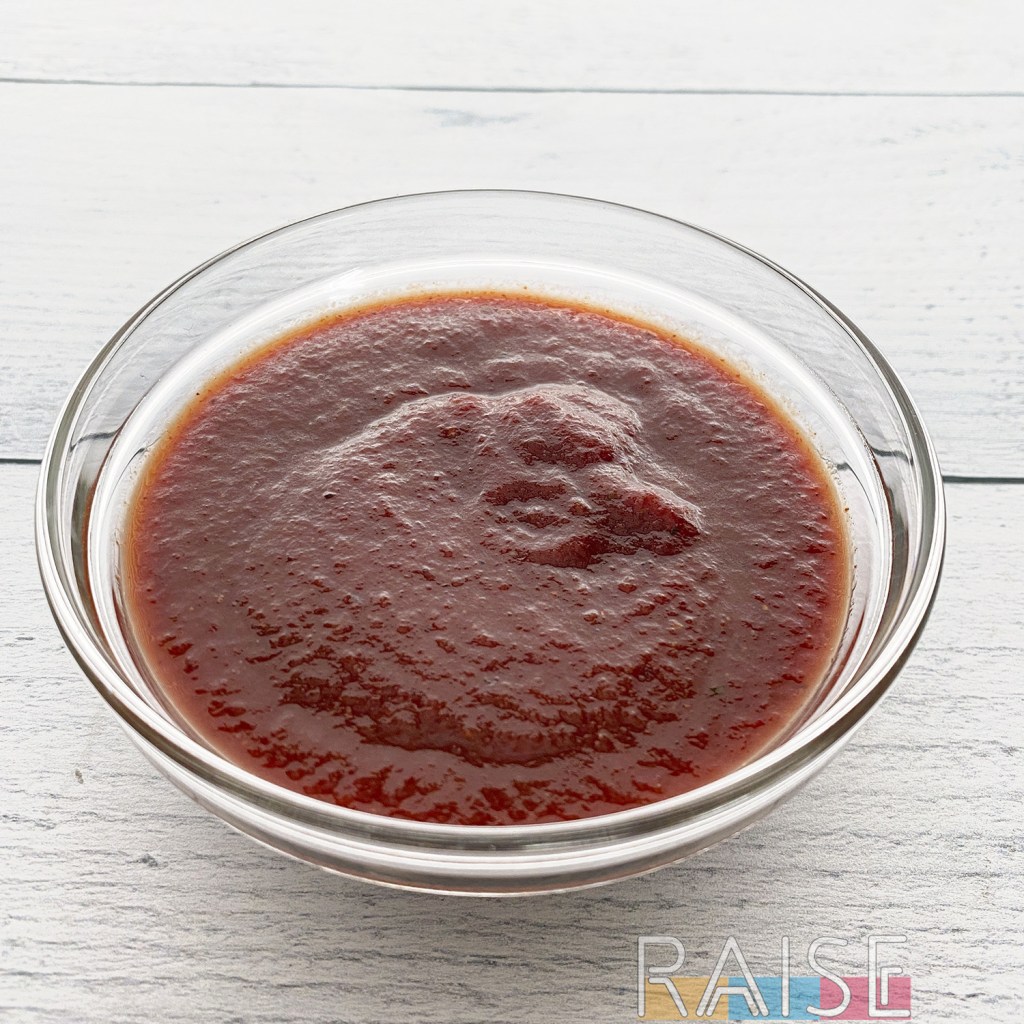
- Kid Friendly, Allium Free BBQ Sauce Recipe
 |
 |
 |
 |
 |
 |
Answering Your Onion Allergy Substitute Questions
What’s a good substitute for regular onions in lentil dishes?
You can use leeks and shallots in lentil dishes to replace the flavor of regular onions. You can add a little sliced fennel bulbs to round out the flavor as well (don’t use a tonne). Alternatively, you can season with asafoetida and a little fennel seed to bring in a lovely flavor profile that will compliment your lentils.
Start with 1/4 teaspoon to 1/2 teaspoon at the start of cooking if you opt for asafoetida. As it cooks, sample and ensure you like the potency and add more if needed.
I have garlic and onion allergies. What are suitable replacements when cooking?
The top two suitable replacements when cooking will be leeks and shallots. They’re both in the allium family, and will bring onion-like qualities to your stove top recipes (and oven roasted foods as well).
You can use them in soups, stews, spaghetti, burgers, and anywhere else you’d normally want to use onion and garlic. You can’t purchase a powder like you’d be able to with leek or shallot. However! And this is exciting… You can purchase dried leeks and dehydrated (or freeze dried) shallots. Once you have them, run them through a spice grinder and it’s like having your own onion powder, but onion free. How EPIC is that?!
OK, now let’s say you can’t have leek or shallot. Asafoetida will be your next best bet. Above in the article, I outline how you’ll want to use it in recipes. You can also pair it with other ingredients to create a more complex flavour profile that I think you’ll enjoy.
I follow a low FODMAP diet. Can I have onion infused oil?
This is going to vary by person, but typically, a garlic-infused oil or onion-infused oil won’t cause the GI issues people manage when eating high FODMAP foods. Now, I have to preface it with this: if you manage an onion allergy you cannot have onion infused oil. If you manage an onion intolerance, you may or may not be able to tolerate this product.
Now, on to the why. FODMAPs are water soluble. When you take a clove of garlic and put it in oil (fat) the FODMAPs don’t leech into the oil the same way they would a broth (water based). What this means is that we can confit the onion or garlic in oil at a low temperature to capture the flavour and essence, without any of the FODMAPs. Pretty neat, right?
Whilst this is a great option, as always, keep a detailed food journal, as no two people are the same. On the off chance you’re not able to tolerate an infused oil, your journal will have good notes, and it’s something you can review with your medical team.
What are some good onion and garlic substitutes for spaghetti sauce?
I’ll always tell people, assuming they’re not allergic to all alliums, that leeks or shallots are going to be the top onion and garlic substitutes to lean into.
They’re going to bring a great onion quality to your spaghetti sauce (as well as stews, soups, and other savory dishes).
Now, if you can’t have any alliums, this is where the real fun begins. Well, fun for me because creative solutions and all that jazz. In a spaghetti sauce, we really want to replace the taste and the bit of texture from cooked onions (assuming the recipe calls for a fresh version of onion & garlic rather than powders or granules).
For a bit of texture, you’ll want a thin sliced vegetable such as zucchini. Use a mandoline (this is good low cost option for occasional use) to very thinly slice the zucchini, but then also cut the slices into smaller pieces with your knife so they resemble sliced onion. When that cooks down, there will be a little flexibility to it, and when well seasoned, it will give you onion texture vibes.
Now, for the flavor. We’ll tap into a combination approach of asafoetida powder (also called hing) along with a little mushroom powder for earthy notes and a pinch of fennel seeds. Depending on the amount of garlic powder (or fresh garlic) the recipe calls for, you’ll adjust how much you need. For the final bit, add a little ginger or wasabi. These are going to bring in that bit of kick that garlic brings to the table.
As for amounts… let’s look at a hypothetical, then you can do some ratios.
- 670mL/24 ounces Strained Tomatoes (AKA Tomato Sauce)
- 112g/4 ounces Thin Sliced/Cut Zucchini (courgette)
- 1.5 tsp Smoked Sea Salt
- 3 TBSP Organic Maple Sugar
- 2 TBSP Organic Dried Marjoram
- 1 tsp Organic Mushroom Powder
- 1 tsp Organic Ground Ginger OR Wasabi to Taste
- 1/2 tsp Organic Fennel Seeds
- 1/3 tsp Organic Asafoetida Powder
This is a hypothetical that’s a great starting point and has a lot of wiggle room to add protein, and a lot of other seasonings to jazz up your sauce.
Now, will that approach scream I am onion and garlic, hear me roar? No, so always manage your expectations. Instead, they’ll have an oniony flavour, but overall, will help you create an incredibly delicious spaghetti sauce, and that’s our ultimate goal.
What’s a good onion substitute for stews?
One of the best products you can use will be asafoetida. It’s a great way to bring in onion flavour, without the onion. You’ll want to pair it with something of bulk such as parsnips, and maybe even a little fennel seeds. This three pronged approach will bring in the flavour, texture, and body that onion pieces normally bring to stews.
If you’re not allergic to shallots or leeks (both alliums, but not onions), they’ll actually be your first line of defense. Both have their own unique flavour, but both also bring an onion-like flavour to the table. In a stew using at least 1.3KG/3 pounds of meat, I’d start with at least the white portion of 3 leeks, or 6 – 8 shallots.
How can I make a good cajun recipe without onion?
As you may have guessed, my answer is going to take on a combination approach to getting great flavor into your cajun recipe. The first thing you’re going to want to do is lean into aromatic ingredients such as celery and bell pepper at the start of cooking. In addition to bell peppers, use peppers that are less mild, but super flavourful (habanada, banana, etc.).
Assuming you also like spicy foods, pick out a few spicy peppers that have a nice flavour quality, rather than just HEAT. Look into fruit peppers as a way to achieve this goal.
If you’re not allergic to leek or shallot (both in the allium family, but not onions), lean into those pretty hard. You’ll want to use the white portion of 2 leeks or several shallots in each batch of your recipe. This will bring back some of the sulfur compounds that onions are well known for.
Now, if you’re allium free, this is where asafoetida is going to come in and save the day. You’ll want to use at least two teaspoons in your recipe, and add it near the start of cooking. If you add it near the end of cooking, it won’t have enough time to develop the flavour, and cook off the pungent smell it’s known for.
With this kind of combination approach, I think you’ll be happy with the end results. Happy cooking!
Are there any cuisines that don’t use onions, or use onion minimally?
The world is rich with so many different cuisines, and unfortunately, they’re all pretty rich in onion and other alliums. Foods that use onions minimally are going to be simple recipes for foods like steak, or oven roasted potatoes.
Japanese foods are generally lower in onions and alliums, especially foods such as sushi. Raw fish in general (crudo, etc.) are going to include little to no onions or alliums, as they lean more into acids and peppers.
Another food that uses onions minimally is going to be raw food. Raw foods are a category of vegan foods and they lean heavily into fresh herbs, nuts, and seeds.
Some traditional African recipes are easier to make allium free since they lean heavily into other spices. When you leave the onion out, it doesn’t scream “something is missing” because your taste buds are distracted by the heat, and other ingredients.
The same is true of Indian food. It’s going to be easier to leave out the onions from an Indian recipe than a French recipe. Hopefully this gives you some inspiration and you’re able to find some delicious onion free recipes to enjoy.