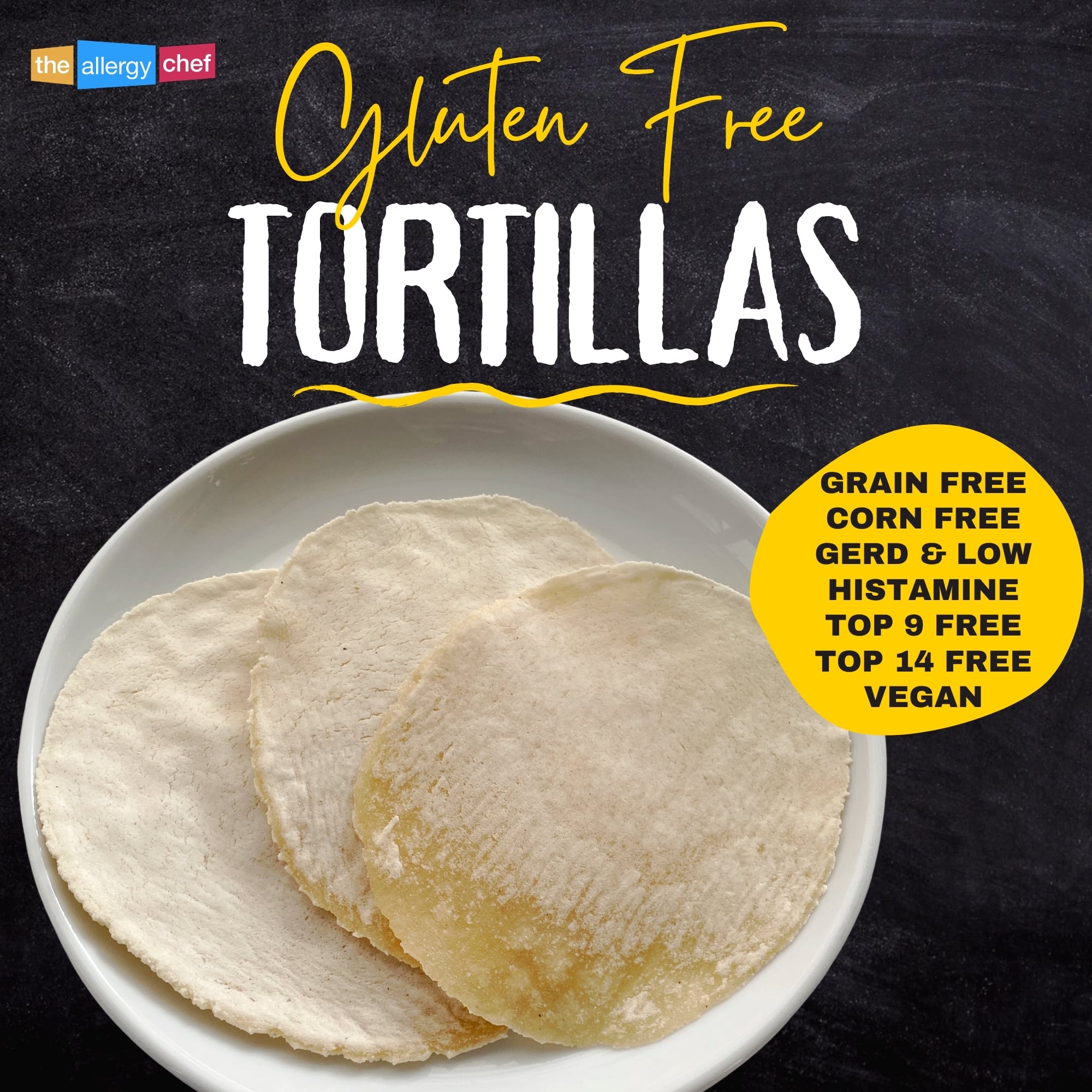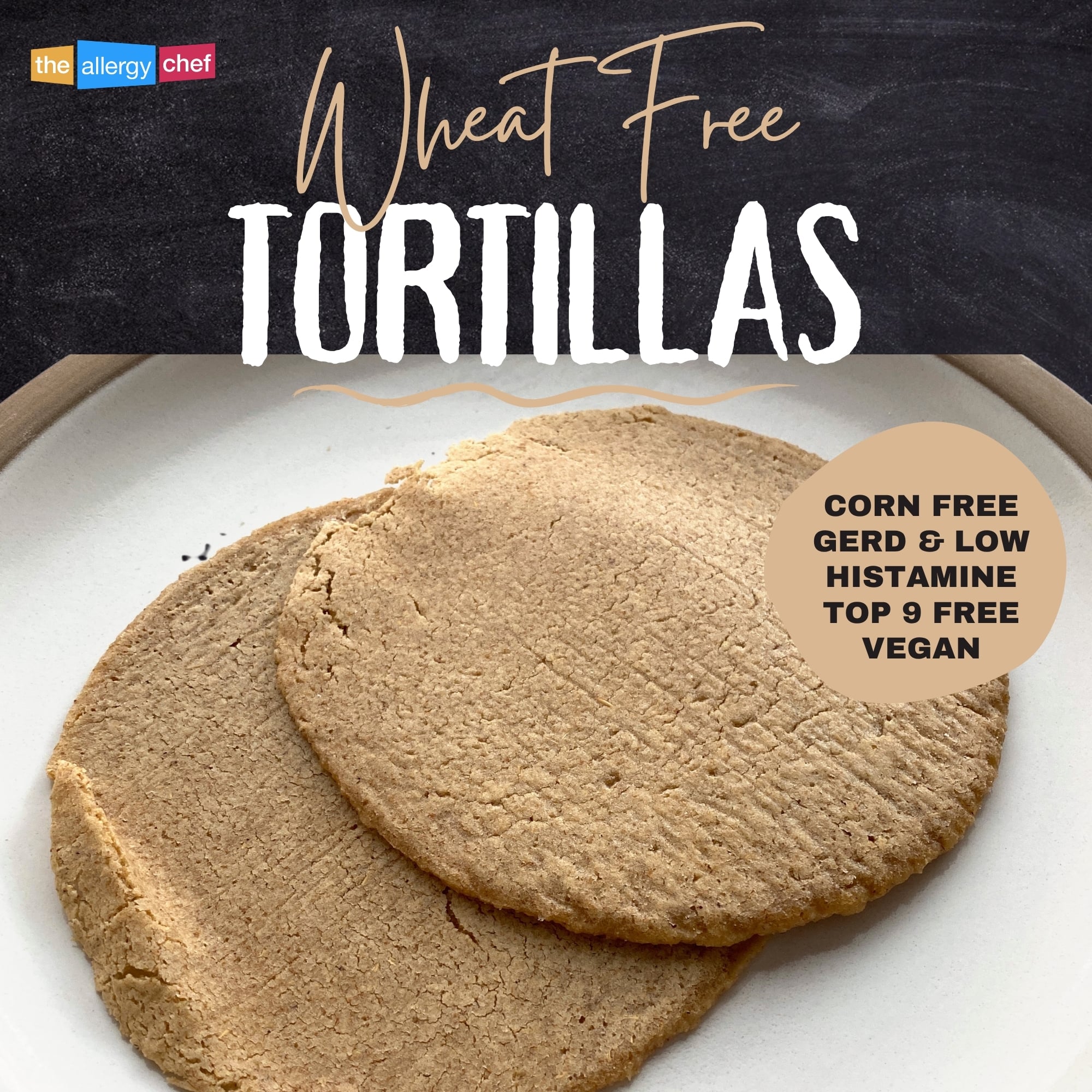
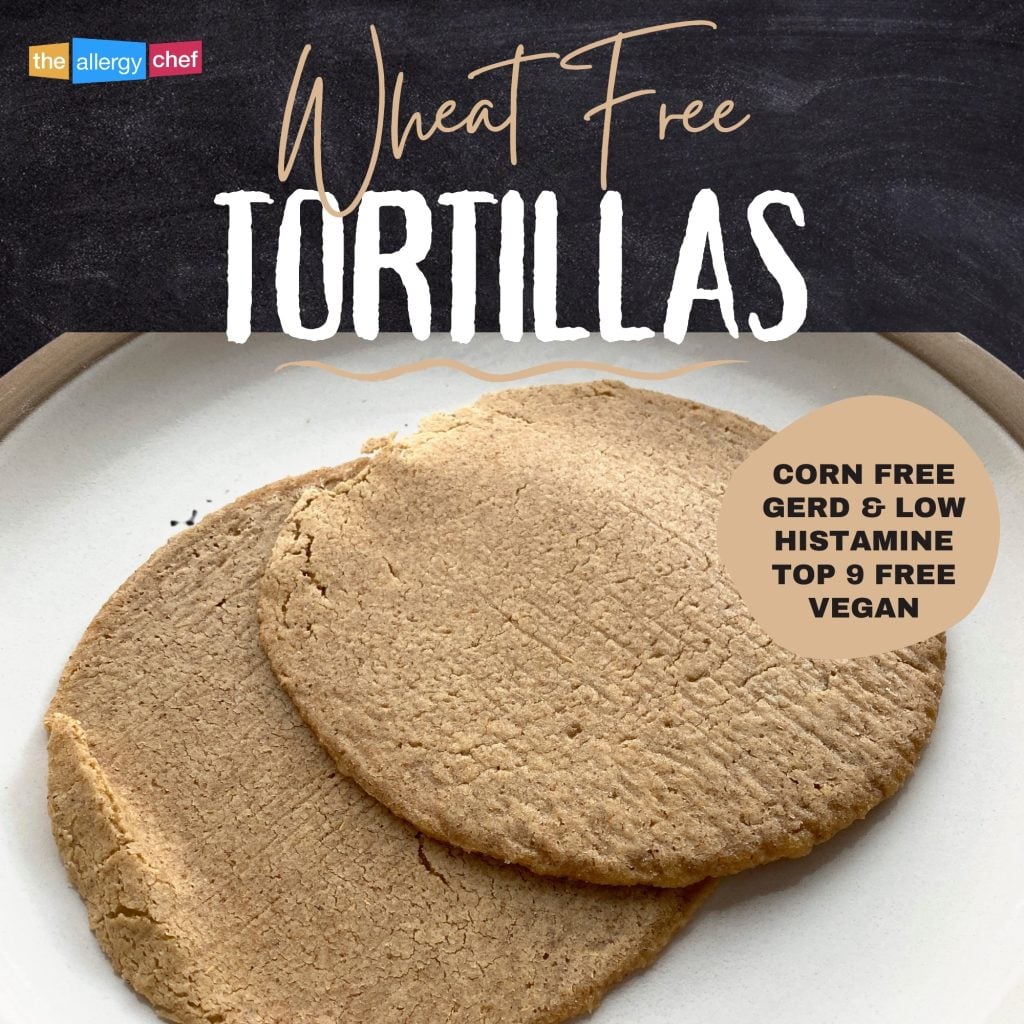
Today I’m going to show you how to make a gluten free flour tortilla recipe that’s a cross between a flour tortilla and a corn tortilla. I like to call these Street Taco Tortillas, as a reminder of those cool taco carts you see. Except, as someone with an anaphylactic allergy to corn, there’s no way I’m making authentic street corn tortillas.
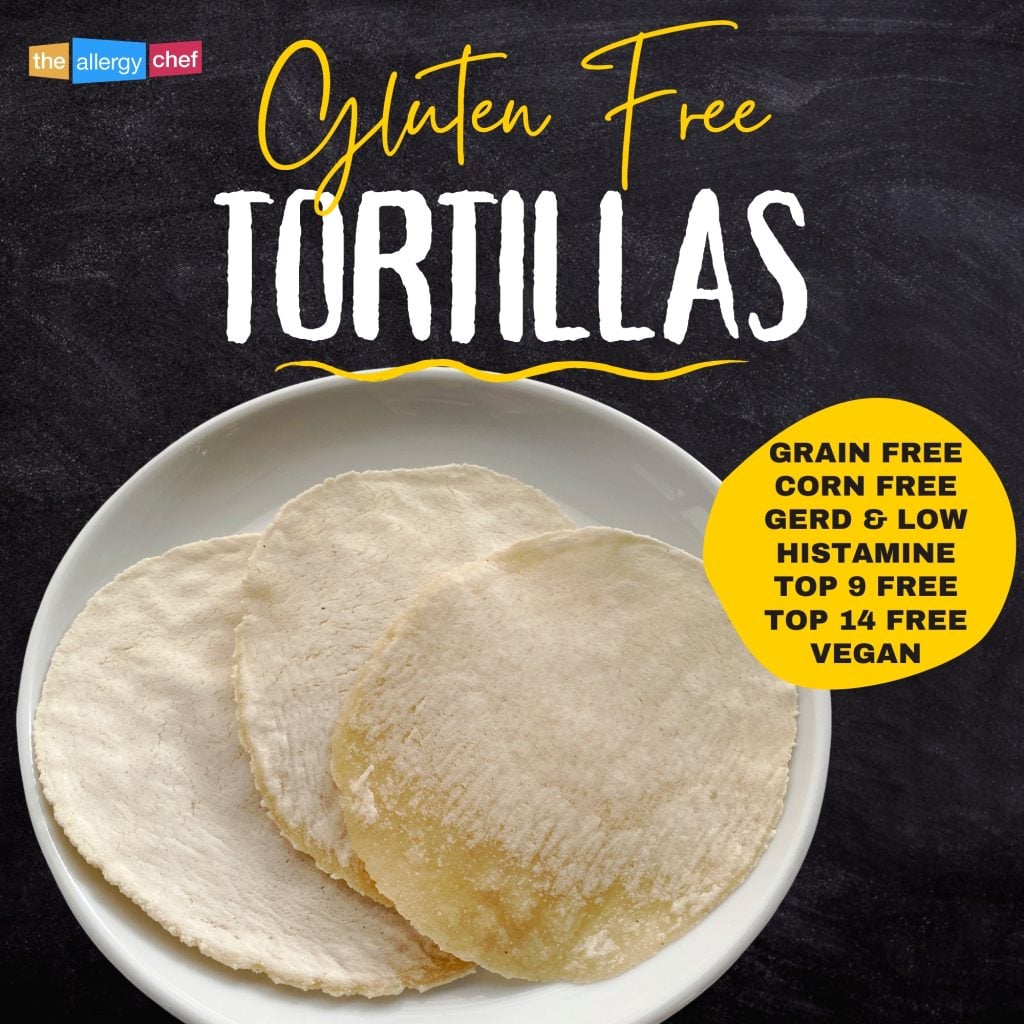
These delicious beauties are not only gluten free, but top 9 free, top 14 free, and more. They’re also well seasoned, which gives them the ability to be a good supporting vessel to a lot of other delicious recipes.
In addition to regular ingredients and directions, you’ll also find a troubleshooting section today because I won’t lie, the first time you make homemade tortillas, you can take a wrong turn. Now, let’s get to work.
Gluten Free Tortillas to Purchase: If you found this recipe whilst looking for gluten free tortillas to purchase, view tortilla reviews here for product leads.
Allergy Status
Free From: Wheat/Gluten, Dairy, Egg, Soy, Tree Nuts, Peanut, Fish, Shellfish, Sesame, Top 9 Allergens, Top 14 Allergens, Apple, Avocado, Banana, Beans & Lentils, Berries, Buckwheat, Cane/Refined Sugar, Carrot, Celery, Cinnamon, Citrus, Coconut, Corn, Cruciferous, Garlic, Latex Cross Reactive Foods (H/M), Legume, Lupin, Mushroom, Mustard, Nightshade, Oat, Onion, Pea & Pea Protein, Potato (Nightshade Variety), Poultry, Red Meat, Rice, Squash & Gourd, Stone Fruits, Strawberry, Sweet Potato & Yam, Tapioca/Cassava/Yuca/Manioc, Tomato, Yeast
Friendly To: EOE, FPIES, Low Histamine, Vegan
- Low Histamine Reminder: Use a safe onion powder or onion granules for you. For some, it needs to be homemade.
Tools Needed to Make This Gluten Free Tortilla Recipe
- Kitchen Scale
- Mixing Bowl + Fork OR Stand Mixer + Paddle Attachment
- Flour Scoop or Large Measuring Spoon (for scooping)
- Tortilla Press (this is what I LOOOVVVEEEE)
- Parchment Paper
- Pan + Spatula (if you’re cooking on the stove top)
Whilst a tortilla press is special equipment, if you don’t have one, in the directions, I’ve included an option for using a rolling pin, just in case.
Gluten Free Flour Tortilla Ingredients
Part 1 Ingredients (Dry Ingredients)
- 160g Millet Flour, Superfine
- 90g Sorghum Flour, superfine OR Brown Rice Flour, superfine
- 3/4 tsp Sea Salt
- 2 – 3 tsp Organic Onion Granules
- 2 TBSP Organic Maple Sugar
- 2 tsp Organic Dried Parsley
Part 2 Ingredients (Wet Ingredients)
- 4 TBSP Oil of Choice or Melted Lard
- 195mL Water (7 ounces, room temperature, use this water for truly corn free)

Very Important Ingredient Notes
Millet Flour: Millet is a seed based gluten free flour. It’s also the most important ingredient for getting these homemade flour tortillas to taste like corn. It’s not advised that you swap this flour. If you need seed free + GF + vegan + etc (because my recipes are inclusive), for best results, try this gluten free flour tortilla recipe instead.
Sorghum Flour: This is a supporting gluten free flour and can be swapped for the listed brown rice flour, or for an all purpose gluten free flour. Do not trade it for a single strong flour such as chickpea flour or buckwheat flour. Also, don’t trade it for a special flour like almond flour or coconut flour.
Onion Granules: This is going to give the tortillas some flavour. You can change this for a different seasoning, or omit.
Maple Sugar: Some gluten free flours have a taste, and it’s not always awesome. Sorghum flour and sometimes millet flour can register the wrong way. The maple sugar is here to offset that. You can use other granulated sweeteners. For best results, stick with unrefined sweeteners such as coconut sugar or date sugar.
Oil of Choice: For tortillas, I like to use organic tiger nut oil (tuber, not a tree nut). Tiger nut oil is like… a Ferrari and a Rolls Royce came together to build an even better car. There’s literally no other oil like it. It tastes fabulous in a neutral way, but it’s also pleasant. It has lovely notes, but again, still neutral. Why you need to know that:
Yes, you can use other oils when making these gluten free tortillas, however, each oil comes with a TASTE. If you plan to use your tortillas for something traditional like tacos, avocado oil is a great choice. Olive oil, depending on your taste buds, might not be the best choice.
Just know that pretty much all fats will allow the tortillas FUNCTION, but they don’t all taste good. So, keep that in mind if you have to make a swap. Your oil needs to TASTE fabulous, or taste like absolutely nothing so you forget that it’s there.
Lard: When it comes to creating a pliable dough and flexible gluten free tortilla, fat is the most important ingredient. Yes, you can use an oil of choice to make sure your vegan friends can eat the tortillas with you. However, if you want something that’s super close to what you’ll find at the grocery store, lard is the answer.
To use lard, you’ll want to melt it down first, then use it like an oil. You can also use tallow and whilst I’ve tested it, my advice to you is this: only use it if you LOVE the taste of your tallow. It’s a very forward and present taste.
Salt: If you plan to batch cook, please read the scaling note further down.
The Power of Simple Ingredients
You may have read that for flexible gluten-free tortillas you need ingredients like tapioca starch or psyllium husk. Now, psyllium husk is AMAZEBALLS TO THE MOON AND BACK when you’re making gluten free bread (especially gluten free + egg free bread), but that’s not what we’re making.
Sometimes, the easiest way to have gluten free success is to ditch dough conditioners and extra ingredients and simply lean into simple ingredients that will WORK.
We can focus on flavour and mouthfeel, and in the case of gluten free tortillas, take advantage of the fact that they’re thin, unleavened, and not expected to rise. Sure, in gluten-free baking we can’t always go simple (I ran a free-from bakery, so I know what it takes to have success). But in cooking, we don’t always need an advanced flour mixture.
Instead, we just need a few solid gluten free flours that can PERFORM. Yup, it’s simple ingredients for the win.
So, take a look at the ratios and play with the base as needed (or wanted), because *THAT* is where innovation happens. I really hope this gluten free tortilla recipe inspires you to do more in your kitchen (in a fun way, not an exhausting way). Don’t be afraid to take something simple and mess about, so long as you’ve followed the recipe forreals at least once, and understand what it’s really supposed to do.
More Gluten Free & Wheat Free Tortilla Recipes
- Super Flexible Gluten Free Tortilla Recipe (grain free, truly corn free, and more)
- Easy Wheat Free Tortilla Recipe (oat based)
- Corn Tortillas vs. Flour Tortillas: What’s the Difference?
- How to make Awesome and Healthy Tacos at Home (with great recipe concepts to try)
 |
 |
 |
 |
Homemade Gluten Free Flour Tortillas Instructions
THIS IS THE ELECTRIC TORTILLA PRESS THAT WILL CHANGE YOUR LIFE FOREVER. Yup, I’m yelling because that’s how much I love it. In fact, I’d never thought to make gluten free flour tortillas at home until I saw a friend use one. Seriously. Life. Changing.
Why am I telling you that? Because you’re going to need a tortilla press and yes, you can spend $10 and get a regular one, or. SPLURGE. Get the electric one and have so much fun, and never have to do the thing where you struggle to get the raw tortilla dough to release because it got stuck to the plastic wrap.
Now, for the tortilla dough. Personally, I use a stand mixer to make gluten free flour tortillas, however, you can mix by hand in a large mixing bowl with a fork. Either way, place your bowl on your kitchen scale, tare to zero, and add the Part 1 Ingredients.
Gently mix together to make sure everything is well distributed, tare to zero, then add the water and oil/lard/fat. Mix again until a dough ball forms. Yup, it was that easy.
Once you have a dough ball, place it on a large piece of parchment paper. Personally, I find this easier than working on a lightly floured surface and all that jazz, plus, way less cleanup.
So, the dough is on the parchment paper. Roll it out into a thick log like it’s kindergarten all over again, then break the log into 11 – 13 dough balls (you’re aiming for golf ball-sized pieces of dough). 10 – 11 dough balls will create thick tortillas, FYI. For a more standard thickness, aim for 12 – 14 dough parts.
Take each portion and roll it into a ball. If you skip this step, it’s not the end of the world. When you press and cook a non-ball shape, rather than have a smooth round edge, your tortillas will be jagged all over. Trust me, your taste buds won’t know the difference.
OK, you’ve got dough balls. Now, you press and cook. That’s it. In my case, with the electric tortilla press, rather than use two pieces of parchment paper which can be a pain in the long run, I rip off a piece twice as big as the tortilla press, then fold it in half. The dough ball goes between the two sides of parchment paper, I press down, and leave it to cook.
IT’S SO EASY I COULD CRY TEARS OF JOY. I really hope all those caps express what an electric press can do for you. Now, if you don’t have an electric press, keep on reading.
How to Shape Your Gluten Free Flour Tortillas Without a Press
If you don’t have a tortilla press, don’t worry, you can still make this tasty gluten-free recipe. Once you have the dough portioned into 11 – 14 parts, take a portion and roll it into a ball. Now place the dough ball between two pieces of parchment paper. Use a rolling pin to roll the ball out to be about 6″/15cm wide.
Cook your tortilla on the stove top (more on that below). Whilst it’s cooking, move on to the next dough ball. By the time the tortilla is done cooking, you have the next one ready to cook. Repeat until there’s no remaining dough balls.
No rolling pin? No problem. Get something that resembles the shape of a rolling pin and use that. You’ll have to hold it kinda funny, but as long as you can roll out the dough, it will work.
You can also press down with your hands, but I’ll warn you, it’s a lot harder to have a consistent thickness when doing that, and you risk having a gummy texture in the thicker parts of the tortilla.
How to Cook Your Gluten Free Tortillas Without an Electric Press
OK, I’ve told you about my way (and how incredibly easy it is), but let’s look at how to cook gluten free flour tortillas the old fashioned way.
Once you have the tortilla dough portioned, you can flatten them and have them ready to cook. If you opt to flatten each piece of dough all at once, have a damp towel next to you to keep the tortillas from drying out. You’ll also need to have a small piece of parchment paper between the layers of raw dough so it doesn’t stick together, then keep the stack covered with the damp towel.
Heat a truly nonstick pan or a cast-iron skillet on medium to medium-high heat. Once you have a hot pan, use a large spatula to transfer a tortilla disc to the pan to cook. Large is important because you don’t want the raw dough hanging off of the spatula, which can cause it to break.
Allow the tortilla to cook for 30 – 45 seconds on the first side. It should start to look a little dry. Flip it over to cook the second side. It’s OK if bubbles form. Your tortilla should be dry, and not be gummy in the center. If it’s looking a little wet, flip it over again and continue to cook until you have something that resembles the tortillas you see at the grocery store.
Whilst I won’t call this hard work, it won’t be nearly as quick or easy as the electric tortilla press, so maybe plan to get one if you’re going to make gluten free tortillas at home on a regular basis.
Important Scaling Note
If you’ve read my recipes before, you know that scaling (for the sake of batch cooking and freezing) is always at the forefront of my mind. Tortillas have a caveat that you need to be aware of.
If you want to make more than one batch, reduce the salt. I can’t quite give you a guideline but what I can tell you is that if you 2, 3, or 4x the batch AND scale the salt up, it will be too much.
You’ll want to trust me on this one, because I’m always testing stuff out. If you don’t reduce the salt when scaling up, your tortillas will have way too much sodium and you won’t want to eat them.
Delicious Taco Recipes
- Homemade Taco Seasoning (I include a few options to choose from)
- Easy Chicken Taco Recipe for Kids and Adults
- Delicious Gluten Free Tacos Recipe with Lamb (though, you can use a different ground meat)
- Leftover Taco Meat Meal Ideas (super handy if you like to batch cook taco meat, or just made too much the other day)
 |
 |
 |
 |
Troubleshooting Your Gluten Free Flour Tortillas
Whilst this isn’t my go-to recipe for gluten free tortillas (it’s this one, this is the go-to recipe), the good news is, I’ve done quite a bit of experimenting. Based on my adventures, let’s look at some problems you might run into, and how to fix them.
Rather than pliable tortillas, you have hard/crunchy tortillas that break.
When this happens, it usually means you’ve cooked the tortillas for too long. Now, I will tell you, I’ve used this “hack” to make amazing truly corn free + gluten free crackers in my tortilla press. It’s like, SO MUCH easier than the regular cracker making method.
For a flexible tortilla though, it’s lame. So, turn the heat down on your electric tortilla press, or turn the heat down when cooking on the stovetop. It’s as simple as that to fix this issue. Your cooking time may stay the same, or be a bit longer, but in the end, you should have a flexible tortilla, not a crunchy chip.
Another way this happens is if your tortillas are too thin. They can become brittle and crunchy when cooked, so make sure they’re a good height.
Your ball of dough doesn’t remind you of Play-Dough.
In most cases, it’s going to come down to the moisture content of your gluten free tortilla dough.
WET/RUNNY: Somehow, you have too much liquid in the batter. Play-Dough has some firmness to it. If your tortilla dough feels more like it’s on it’s way to applesauce territory, it’s much too wet.
This can happen if you mix by hand, and think there isn’t enough water to bring the dough together, add more water, then keep on mixing. By the time you’ve got dough, it’s too wet.
To resolve this, you need to add more flour. Start with 2 – 3 Tablespoons, mix completely, then assess. If you overshoot, then you end up doing that thing where you keep adding a little of each one, trying to get back to the sweet spot.
DRY: If for some reason you walked away from the dough and left it in your large bowl (or bowl of a stand mixer) uncovered, the dough will dry out… just like Play Dough, now that I think about it. Which is kinda funny not funny.
The solution though, if you need to walk away and not make tortillas in the moment, is to place the dough ball in an airtight container, or cover it with plastic wrap, or place a damp paper towel over the dough to keep it a little moist. Make sure all edges are completely covered.
FIXING TIPS: Now, to fix a tortilla dough, you’ll be adding more water, or more flour. One time, I had too much liquid, and to figure out how much flour to add, I went back to the basics: addition.
Your gluten free tortilla dough should weigh around 510g in total. In my case, I put a fresh bowl on the scale, hit the tare button, then transferred all of the dough into the clean bowl. With the new weight, I knew how much extra water was in the mix, which then made it EASY to determine how much flour to use to get back to the sweet spot.
That only works if you know where you went wrong. If you’re not sure, it’s simple. Too wet = add flour, too dry/won’t form/crumbles = add liquid. Usually, I add a 50/50 mix of oil and water if it’s a small amount of liquid. This ensures that you don’t lose your flexibility (that’s the function of the fat).
When you cook your gluten free flour tortillas on the stove top, they keep burning.
First, make sure you’re using a truly non-stick pan so you don’t need a spray or oil. Next, turn down the temperature. There’s a good chance that the heat is too high, so your tortillas burn on the outside before they’re fully cooked on the inside.
Your gluten free tortillas have a gummy texture when cooking with the electric tortilla press.
If your tortilla dough is too thick, you can have a gummy texture in the middle of the tortillas.
Additionally, if your cook time is too short, you can have a gummy texture in the middle of the tortillas.
If you made 11 or 12 dough balls, make 13 or 14 next time and try again. If you made 13 or 14 and still have a gummy texture, you need a longer cook time, (or need to press down a little harder when you put the dough ball into the press). Check after an extra 30 seconds to see if that’s enough, or bump it up to another minute with the electric press. You can also increase the heat dial a little bit (I keep mine close to the center).
When you make this gluten free flour tortilla recipe, your tortillas stick to the tortilla press.
If you use an electric press, I describe in the instructions how I use parchment paper. Do that and you’ll NEVER have a sticking issue. I’ve made probably 500 tortillas this way? Like, a lot of tortillas, and no sticking.
If you’re using a traditional, non-electric tortilla press, you’ll want to cover the two plates in plastic wrap or some kind of barrier. It needs to be an item that the dough won’t stick to.
Since I don’t have one of these, I don’t know if parchment paper will work, but that’s the ideal material to use. However, I’ve only seen other chefs use plastic with those presses, and there might be a reason why.
Either way, you have to have a truly non-stick surface for your tortilla dough to be pressed against so it can release easily.
You froze your gluten free flour tortillas and they’re stuck together.
One time, I was at the grocery store and saw the most amazing extra large gluten free burrito wrap/tortilla product in the freezer section. I buy it for my kids to try, get it home, open it, and ALL of the tortillas are stuck together. I was so pissed. Literally, no way to break them apart. Just a frozen solid stack of useless tortillas (that were EXPENSIVE).
So, to prevent this, the solution is simple. As you stack cooked tortillas, place a small parchment paper circle between the tortillas. Now, here’s where it gets better with a little planning.
When you have extra time, cut 30 small parchment paper circles. Place them in a freezer baggie, and label the freezer bag Tortillas. Now, each time you make tortillas, you use that bag and the parchment circles. You can REUSE THEM OVER AND OVER. I did this for like, two years. Just kept adding and taking from the bag and it was magical and the little parchment circles were the best idea ever.
I kid you not. I’d make a batch, have a couple of tortillas left over, slip them into the bag and use the parchment that was already there, and move on like I’d had a luxury experience. So please, do this.
How to Store Your Gluten Free Flour Tortillas
Great news! I’ve tested these gluten-free flour tortillas in the freezer and it works. For cooked tortillas, the key is to freeze your tortillas with a piece of parchment paper between each one. This also allows you to also only pull what you need in the future. To thaw, leave frozen tortillas at room temperature.
Alternatively, you can freeze tortilla dough balls! I’ve decided that I like this method better since you can thaw the dough balls then make the tortillas fresh as needed. However, this won’t be practical for everyone.
If you have extra cooked tortillas, I’ve found that after about 15 hours they’re meh at best when stored at room temperature. They’re a bit better if they had been in the fridge, and then were reheated. The best leftover tortillas come from the freezer. Outside of that, honestly, the fresh ones really are the best, and they’re not too difficult to make.
You can also fridge uncooked tortilla dough balls in an airtight container for a few days, and make tortillas fresh each time you’d like them. When doing this, I like to bring the dough to room temperature before cooking.
Do not store leftover cooked tortillas in the refrigerator. You won’t be happy with the results.
Great Ways to Use Your Gluten Free Flour Tortillas
Whilst tacos and burritos are the most obvious uses for gluten-free flour tortillas, there’s a lot more you can do with your loot, so let’s take a look.
The first time you make this gluten free tortilla recipe, stick to the ingredients so you have a working knowledge. Then, the next time you make these, here are a few ideas to try:
- Add a few pinches of garlic powder or garlic granules to compliment the onion.
- Add a little tomato powder to the tortilla dough for colour and hint of flavour.
- Include dried mushroom powder in the dry ingredients (1 – 3 TBSP) for depth and umami.
- Use smoked salt instead of sea salt.
More Delicious Ideas:
- Baby Tortillas! (rather than make full sized, make little cute tortillas and use as a base for fancy appetizers, bonus points if you call it an amuse bouche)
- Breakfast Burritos (these creamy breakfast potatoes could be the base of your filling, add sausage, and a few other bits and bobs)
- Cookie Cutter Tortillas! (press the dough, use a cookie cutter, remove excess dough, then cook for a really fun result)
- Homemade Tortilla Chips (Also Nachos)
- Cut Cooked Tortillas Into Strips & Fry (great as a crunchy salad topping etc.)
- Tostadas! Fry up cooked tortillas until they’re nice and crispy, add seasoned refried beans, and any other toppings you love)
- Use as an Alternative for Pizza Dough (basically, spread tomato paste on a cooked tortilla, add seasonings, cheese, and your favourite toppings, cook, then grab a fork and dig in)
- Call These Gluten Free Tortilla Wraps and Make BLT Wraps (and other delicious wraps, like a tomato, basil, and cheese wrap or something super tasty, sky’s the limit here)
**Whilst these technically these are tortillas for taco night and aren’t wraps, you can treat them like one and add your favorite fillings. Don’t forget to add a delicious dip.
 |
 |
Answering Your Questions About This Gluten Free Flour Tortillas Recipe
How do these taste compared to a corn tortilla?
Based on what tasters have told me, these gluten-free tortillas reminds them of a corn tortilla. If you’re allergic to corn, and you’re gluten free, and you want a tortilla that reminds you of a corn tortilla, this gluten free flour tortilla recipe is what you’ve been searching for, and that’s all down to the millet flour (seed) that taps into its naturally corny flavour.
Can I use wax paper instead of parchment paper when I use the tortilla press?
Maybe. If you’re using an electric tortilla press, no, do not use wax paper. It needs to be parchment paper because of the heat. If you’re using a regular tortilla press when making homemade tortillas, wax paper should be fine.
If you notice that the tortilla dough is sticking to the wax paper and you’re struggling, in a pinch, you can try a gallon freezer plastic bag. Cut down the sides so it opens like a pizza box, pop in the tortilla dough ball, press, and hope for a smooth release.
Is coconut oil a good substitute for the lard?
As a vegan alternative, dairy-free butter would actually be my top suggestion, and that’s only because coconut oil has a TASTE. Now, if you love that taste and want to marry it, yes, it’s a good alternative for the lard.
On the flip side, if you only want to be friends with coconut oil and you’re not even sure why it asked you out on a date… use the dairy free butter. The nice thing is, for this recipe, you can use a fat that’s liquid at room temperature (olive oil, pumpkin seed oil, etc.) or solid at room temperature.
Can I substitute white rice flour for brown rice flour?
For this simple gf flour blend, it should be an OK swap to make. It’s not one that I’ve tested personally, but in theory, you should be OK with that one. However, don’t use sweet rice flour. That would mess up your homemade gluten free flour tortillas.
Is it OK to cook these tortillas on a griddle?
Like pancake batter, yes, you can cook your homemade gluten free tortillas on a griddle. It’s essentially a large hot skillet, just with no sides. Make sure it’s properly heated before you get started, and you’ll be A-OK.
Will these gluten free tortillas really work without xanthan gum?
Great news!! These homemade gluten-free tortillas will absolutely work without xanthan gum. So, it’s important to know that I’m deathly allergic to corn, and can’t use corn derivatives (which is what xanthan gum is). NONE of the recipes I create contain xanthan, unless it’s truly corn free xanthan, which I’ve only used a few times. Honestly, I think there are better solutions, but that’s just my free-from two cents. I digress.
As long as you have a solid gluten free flour blend, AND you’re making something simple, xanthan gum isn’t required. You’ll see it in a lot of commercial products because they need to try to make products “better” without spending loads of money on higher quality ingredients, and that’s one way to do it.
There’s more to it, but I think you get the idea. Basically, start with a strong foundation, and you don’t need support structure like xanthan gum, guar gum, and all their friends.
Could I use my homemade gluten free flour blend for these gf tortillas?
When it’s time for you to make this easy gluten free tortilla recipe, IF your homemade gluten free flour blend is a really, really good all purpose flour blend, then yes. However, if it’s something like, almond flour + tapioca flour, then no.
It needs to be a pseudograin based (not nut based or seed based) gluten free all purpose flour blend with a mix of different flours including a starch, and either two medium weight flours, or a medium and heavy weight flour.
Anything less, and you risk making awful gluten free tortillas. How do I know? I’ve experimented to see what the different flours can do when pushed to their limits.
Are these the same thing as gluten-free wraps?
Sorry to be the bearer of bad news but officially, this gluten-free tortilla recipe isn’t the same thing as gluten-free wraps. Let’s take a look at why.
Proper soft gluten free wraps are usually made with yeast, or at the very least, a leavening agent like baking powder. These fabulous gluten free tortillas don’t have a leavening agent.
Additionally, gluten free wraps are usually made with different flours, and aren’t grain free. And finally, it’s not uncommon for wraps to have a flavouring agent (like herbs, spices, vegetable powder, etc.). Technically, you can add more herbs and spices to this gluten free tortilla recipe, but even then, it’s still not a wrap by definition.
However! Almond. Milk. Yup, we get “milk” from almonds in these modern times so if you want to rebrand and call these gluten free tortilla wraps, you won’t get any push back from me.
Do I need to let the tortilla dough rest before cooking it?
Great news! You absolutely do not need to let your gluten free tortilla dough rest before dividing it and cooking it. Unlike whole wheat flour, we haven’t developed gluten, nor do we need to let the dough rest to halt any gluten development. And unlike a wrap or a leavened dough, we don’t need a rise time. So, just move right on to rolling, dividing, pressing, cooking, and eating one of the best gluten free tortilla recipes I can share with you.
Would I be able to make this gluten free tortilla recipe in a food processor?
Whilst this isn’t something I’ve personally tested, I think you can make this great gluten free tortilla recipe in your food processor since we’re essentially making a dough. Food processors tend to do well with that kind of item, and since you can make pie crust in a food processor (the thickness of the dough is very similar), you should have success.
In your case, place the food processor bowl (with the blade attached) on your kitchen scale. Tare to zero and add the Part 1 Ingredients. Pulse to combine. Then, pour the water and oil/fat into the food processor through the chute whilst it’s on to combine the liquid ingredients with the dry mixture. You’ll find that your tortilla dough forms rather quickly, and then you’re ready to roll. Literally and metaphorically 🙂
Is a cast iron press a good tortilla press?
My understanding is that yes, it’s a good investment, and a good tool to have in your kitchen. Personally, I’ve never used one, and can’t vouch for it. I’ve only ever used this electric tortilla press (and love it to bits).
As long as you get your cast iron tortilla press from a reputable brand, I think you should be good. Be sure to read reviews online and make sure it’s not something weird, or has a surface with paint that flakes etc.
Can I microwave tortillas from the freezer?
Honestly, I don’t know. I don’t own a microwave and couldn’t tell you. Look it up online and see what other people do, then try it with one and see how it goes. Be sure to report back 🙂
What are some easy meals a single person can make with cooked tortillas?
There are so many! OK, here are some ideas to get you started:
- Sloppy Joe or Chili Tacos (tortilla + joe + shredded cheese + guac/avocado) *it has to be a thick, less runny chili*
- Bacon + Egg Taco (tortilla + seasoned scrambled eggs + bacon bits + avocado/guac)
- Lunch Meat Roll Ups (tortilla + spread + lunch meat + sliced cheese)
- Shredded Chicken Tacos (tortilla + shredded chicken + sauce + salsa)
- Pulled Pork Tacos (tortilla + pulled pork + sauce + guac + sour cream)
- Beef Stew Tacos (tortillas + leftover drained beef stew meat + guac + fresh chopped herbs)
With each of these ideas, the proteins cook quickly/easily, and you just add convenience toppings to round out the flavour profile. Easy. Peasy.
Could I use shortening in place of the oil?
Technically, yes. So, when it comes to cooking fats, there are two types, liquid at room temperature (olive oil, perilla seed oil, etc.) and solid at room temperature (coconut oil, butter, dairy free butter, shortening, etc.).
I’ve personally tested this recipe with both types of fat and what it really comes down to is flavor. If the flavor of your fat is noticeable (looking at you tallow), you’re either going to love your GF tortillas, or lowkey hate them. You have to be really sold on the flavor of the fat for it to work.
With shortening, if you love the flavor, or find that it’s super mild and unnoticeable, you’ll be OK. You do need to melt it first before using it and you’ll be good to go. On the flip side, if you find shortening to be a weird taste (like me), it’s not a good option for your GF tortillas.
How does this compare to a traditional Mexican tortilla?
It’s not going to compare. So, I’m all about capturing flavor and texture to remind us of something we’re not able to have due to food allergies, Celiac Disease, and other dietary restrictions.
Corn is unique, however, millet can sort of compare. By harnessing the power of millet, we’re in the right neighborhood, but we’ll never get to the right house, know what I mean? Kind of how gluten free bread recipes are awesome when done right, but it will never be wheat bread because there’s no gluten.
In this case, there’s no corn, so whilst it tries to be traditional Mexican corn tortilla, it isn’t, and, that’s OK. This tortilla has a great consistency, lovely flavour, and it’s the kind of option you can share with your whole family and everyone will enjoy dinner.
In my humble free-from opinion, mission accomplished, even if it doesn’t compare to a traditional Mexican tortilla.